
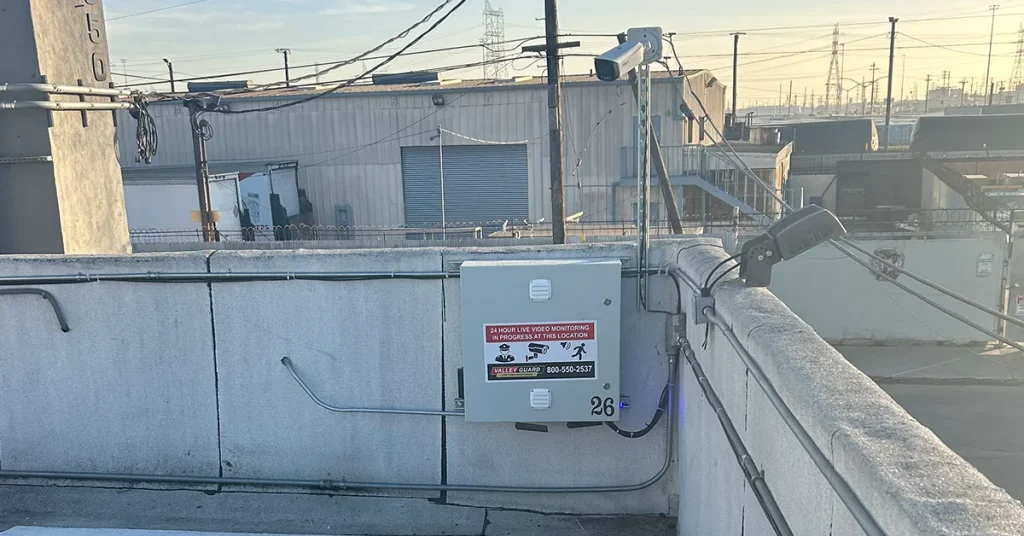
Solar Security Cameras for Cannabis Facilities in Los Angeles
California's cannabis regulations don't leave much room for interpretation on camera coverage. Licensed facilities are required to maintain continuous surveillance of all areas where cannabis is present, handled, cultivated, or stored, including points of ingress and egress.
The compliance requirement doesn't stop at the building door. It extends to the outdoor cultivation areas, the perimeter fencing, and the access points across the entire licensed premises.
The problem is that full perimeter coverage at an outdoor cannabis facility often means covering several acres of cultivated land that has never had electrical infrastructure run to it.
The plants are out there. The cameras need to be out there. The power and network connections are not.
California cannabis operators subject to DCC perimeter surveillance requirements frequently use solar pole-mounted cameras to cover outdoor cultivation areas and remote perimeter points without running electrical infrastructure.
Solar pole-mounted cameras are the practical solution for cannabis operators who need compliant coverage at outdoor positions that hardwired systems can't reach.
The unit mounts to any perimeter pole or fence post, runs on solar power with cellular LTE uplink, and connects to ValleyGuard live monitoring.
There's no power run, no trenching, and no network infrastructure required at the camera position.
Jump to: What the rules require | The outdoor problem | DCC compliance | Deployment
What California's Cannabis Regulations Require
California's Department of Cannabis Control requires all licensed cannabis businesses to maintain a functioning security camera system that provides continuous coverage of the entire licensed premises.
That includes all areas where cannabis is grown, processed, stored, or sold, all access points and entry and exit areas, and the full perimeter of outdoor cultivation zones.
Cameras must be operational at all times, and the recorded footage must be retained for a defined period.
The compliance framework is designed to provide oversight at every point where cannabis could leave the licensed premises without authorization.
For an indoor dispensary, that requirement is relatively straightforward to meet with a hardwired camera system.
For an outdoor cultivation license covering multiple acres, it's a different problem. The licensed area extends well beyond the main building, and the perimeter points that regulators require coverage on are often hundreds of feet from the nearest electrical connection.
A compliance gap at a single camera position is a documented violation. License holders who fail DCC security inspections risk fines, corrective action timelines, and, in repeat cases, license suspension.
Operators who've been through an inspection know that "we couldn't run power to that corner" isn't a resolution. It's the starting point for a corrective action requirement.
Why Outdoor Coverage Is the Hard Part
Indoor cannabis facilities handle the camera compliance requirement the same way any commercial building does: hardwired cameras on building power, tied into the existing security system.
That works for the interior, the vaults, the processing areas, and the customer-facing space. It doesn't work for the outdoor perimeter.
Outdoor cultivation facilities in California, particularly in the Central Valley, desert regions, and rural areas outside the Los Angeles basin, are often operating on parcels where only the main structure has active electrical service.
Running power to camera positions at the far perimeter of a cultivation license means trenching across agricultural land, pulling conduit, and hiring an electrician for a permit-required installation.
For a licensed area spanning several acres, the project can take weeks and cost more than most operators have budgeted for the camera-compliance line item.
Indoor Dispensaries vs. Outdoor Operators
Indoor dispensaries in Los Angeles have a different version of this problem. The building has power.
But the exterior perimeter, the parking area, the loading dock where deliveries arrive, and any fencing beyond the building footprint may not have camera coverage that reaches from interior-mounted positions.
A dispensary operating on a standalone parcel with a fenced lot has the same coverage gap as any commercial property: the building's cameras cover the interior and the immediate exterior, and areas beyond the cable's reach aren't covered.
Solar pole cameras close both versions of that gap. At an outdoor cultivation site, they provide compliant coverage at perimeter positions without electrical access.
At an indoor dispensary with exterior coverage gaps, they cover the lot perimeter and entry approach without requiring conduit work on the existing building.
For the full picture of how solar-powered cameras cover commercial properties without infrastructure, see the complete guide: Commercial Security Without Wiring.
ValleyGuard Monitoring and DCC Compliance
Valley Alarm's solar pole-mounted camera systems connect to ValleyGuard, the live 24/7 monitoring service staffed by US-based Intervention Specialists.
ValleyGuard is UL-listed, which matters for cannabis operators whose licensing requires verified, professional-grade security monitoring rather than self-monitored camera systems.
ValleyGuard's UL-listed monitoring connects solar pole cameras at California cannabis facilities to 24/7 US-based oversight, meeting compliance requirements without the cost of a full electrical buildout at outdoor cultivation perimeters.
When a ValleyGuard camera at a cannabis perimeter detects activity outside licensed hours or in restricted areas, an Intervention Specialist reviews the live feed in real time. If the activity poses a threat or raises a compliance concern, they immediately issue an audio warning through the on-site speaker.
If the intrusion continues, law enforcement is contacted with a real-time description. The response is active, not archival.
The goal is to prevent unauthorized access before it results in product loss or a compliance incident.
ValleyGuard monitors cannabis facilities across Southern California as part of a broader commercial monitoring footprint that covers more than 6,600 incidents in 58 California cities.
The monitoring infrastructure, the Intervention Specialist staffing, and the UL listing apply to every monitored site regardless of vertical.
A cannabis operator's perimeter cameras connect to the same monitoring center and follow the same response protocol as those at any other monitored commercial site.
For more on how Valley Alarm approaches security for cannabis operations, see Valley Alarm cannabis remote video monitoring and the detailed breakdown of outdoor grow site coverage at remote cannabis grow security.
For the full guide to California cannabis security requirements and how licensed operators meet them, see the Cannabis Security Guide.
See documented ValleyGuard interventions across monitored commercial sites, as captured(opens in new tab) on camera.
Deployment at Cannabis Facilities
Valley Alarm's site walk for a cannabis deployment covers the full licensed premises, not just the building.
That means identifying every camera position required for DCC compliance, mapping the positions against existing infrastructure, and designing a deployment that uses hardwired cameras where building power is available and solar pole cameras where it isn't.
At most outdoor cultivation sites, the split is clear. The main structure gets hardwired coverage. The perimeter posts, the access road entry points, the far corners of the cultivation area, and any secondary structures without electrical service get solar pole cameras.
Both systems feed into ValleyGuard monitoring. The DCC requirement for continuous coverage is met across the full licensed area without running power to every camera position.
Valley Alarm can complete a site walk and have cameras connected to live ValleyGuard monitoring within 48 hours of the walk.
For operators approaching a DCC inspection or a license renewal with a known compliance gap, that timeline matters.
Frequently Asked Questions
Do solar pole cameras meet DCC requirements for cannabis security systems?
Solar pole-mounted cameras connected to ValleyGuard meet the core DCC requirements for continuous camera coverage and professional monitoring.
Valley Alarm is a licensed alarm company operating in accordance with California regulations, and ValleyGuard is UL-listed.
Operators should confirm specific compliance details with their licensing attorney or DCC compliance consultant, as requirements vary by license type and may be updated.
Valley Alarm can provide documentation of the monitoring service for compliance review purposes.
What happens if a camera goes down at an outdoor perimeter position?
ValleyGuard monitors camera health in addition to motion events. If a solar pole camera at a perimeter position goes offline, Valley Alarm receives a notification and can dispatch for service.
For DCC compliance purposes, operators need to document camera outages and corrective actions.
ValleyGuard monitoring records provide that documentation. Camera health monitoring is included in the monitored service.
Can solar pole cameras handle the outdoor conditions at California cultivation sites?
Yes. Commercial-grade solar pole cameras are designed for continuous outdoor deployment in varied conditions, including the heat ranges and sun exposure typical of California cultivation regions in the Central Valley and desert areas.
The solar panel recharges the battery bank during daylight hours.
The camera and electronics are rated for outdoor use. These aren't consumer-grade devices mounted on a residential fence.
How does ValleyGuard respond to after-hours access at a cannabis facility?
When a camera detects motion at a cannabis perimeter during a monitored window, a ValleyGuard Intervention Specialist reviews the live feed immediately.
If the activity is unauthorized, they issue a live audio warning through the on-site speaker.
Unauthorized access at a cannabis facility gets the same response protocol as any other monitored commercial intrusion: audio deterrence first, law enforcement contact if the intrusion continues.
Most unauthorized entries end at the audio warning.
Is this the right solution for both dispensaries and outdoor cultivation licenses?
Both, but for different reasons. A dispensary with exterior coverage gaps uses solar pole cameras to cover the parking area, perimeter fencing, and entry approaches that building-mounted cameras can't reach.
An outdoor cultivation operator uses solar-powered pole cameras to cover the perimeter of the licensed area where there's no electrical infrastructure.
Valley Alarm designs the camera placement for compliance coverage in both cases, not just for physical deterrence.
Can Valley Alarm help with a compliance gap before a DCC inspection?
Yes. Valley Alarm can complete a site walk and have solar pole-mounted cameras connected to live ValleyGuard monitoring within 48 hours.
If an operator has a known compliance gap at an outdoor perimeter position and needs it resolved before an upcoming inspection, the 48-hour deployment timeline from site walk to live monitoring is the fastest path to closing it. Contact Valley Alarm to schedule a site assessment.
Perimeter coverage gaps don't survive a DCC inspection.
Valley Alarm can walk your licensed premises and have solar pole-mounted cameras connected to live ValleyGuard monitoring within 48 hours. No conduit, no permit, no electrician. Even at outdoor cultivation positions far from the main building.
Related Articles
- →Commercial Security Without Wiring: The Complete Guide
- →Valley Alarm Solar Pole-Mounted Camera Service
- →Cannabis Security Guide
- →Valley Alarm Cannabis Remote Video Monitoring
- →Remote Cannabis Grow Security
- →Dispensary Robbery Prevention in Los Angeles
- →Solar Security Cameras for Parking Lots in Los Angeles
- →ValleyGuard Catches on Camera

- Remote Video Monitoring: The Complete Guide for Commercial Properties - August 13, 2026
- How Much Does Remote Video Monitoring Cost? - August 13, 2026
- Remote Video Monitoring for Apartment Complexes and Multi-Family Properties - August 13, 2026