
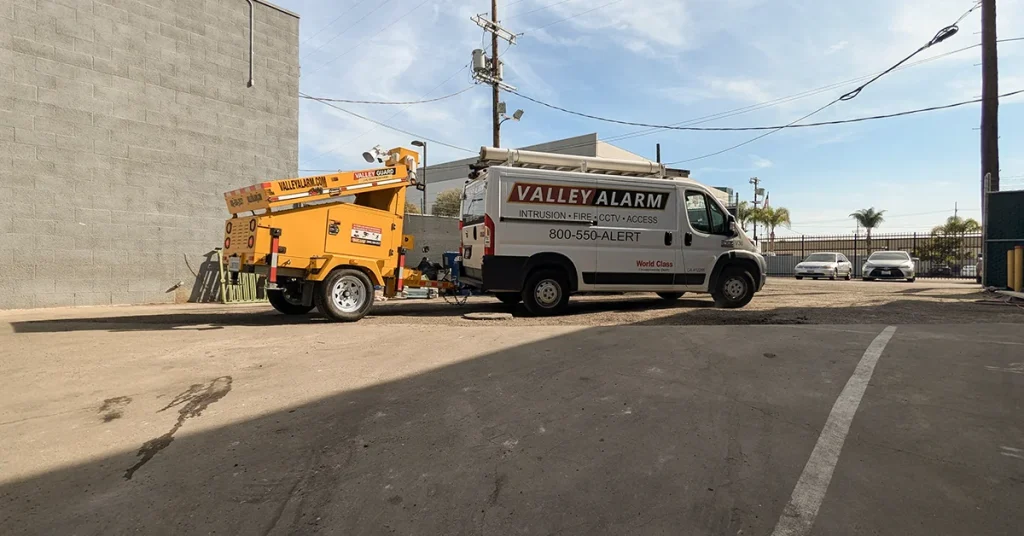
Solar Security Cameras for Warehouses and Industrial Yards in Los Angeles
The cameras on the building are covered. Access control at the dock doors is covered. What doesn't get covered is the back fence line 400 feet from the nearest electrical panel, the yard area where trailers park overnight, or the far corner of a fenced lot that's a quarter mile from the main building.
Those gaps aren't oversights. Running hardwired power to the perimeter of a large industrial yard costs more than most operations budgets will approve, and the disruption to yard operations during installation adds another layer of friction.
So the fence line stays unwatched, and the yard gets hit at 2 am on a Sunday when nobody's around to see it.
Warehouse and industrial facilities along the Inland Empire logistics corridor frequently use solar pole-mounted cameras to monitor perimeter fencing and loading areas that hardwired CCTV can't cost-effectively reach.
Solar pole-mounted cameras mount to any existing fence post, yard light standard, or perimeter pole without any connection to the building's electrical system.
They generate their own power, transmit over cellular LTE, and connect to ValleyGuard live monitoring. The building's camera system covers the building. Solar pole cameras cover the rest of the yard.
Jump to: Where losses happen | The perimeter problem | What ValleyGuard catches | Where they deploy
Where the Losses Are Happening at LA-Area Industrial Sites
Cargo theft across the Los Angeles and Inland Empire logistics corridor is a documented, organized problem.
According to CargoNet, the average cargo theft loss per incident in California reached $273,990 in 2025. That figure reflects full-truckload thefts and organized-operation targets, but it frames the stakes at the high end of what's at risk when a yard's perimeter goes uncovered overnight.
At the facility level, the most consistent losses are lower-profile but just as costly. Fence cuts along the perimeter allow thieves to access trailers without triggering any building-mounted cameras.
Copper theft from HVAC units, electrical conduit, and yard equipment is a consistent problem at industrial sites across Los Angeles County.
Forklift and equipment theft from unsecured yards occurs regularly, particularly at smaller operations that assume the fence is a sufficient deterrent.
The pattern is always the same. The perpetrators identify the camera coverage gap in advance. They know where the building cameras stop. They enter from the fence line, work in the off-camera area, and leave the same way.
The building cameras capture nothing relevant. The footage review the next morning shows a clean building perimeter and no indication of how access was gained.
The Perimeter Problem at Large Industrial Yards
A warehouse or distribution center in the Inland Empire or San Fernando Valley typically has a building footprint surrounded by a much larger fenced yard.
The building has power. The yard perimeter doesn't. Getting power from the building to camera mounting positions at the fence line means trenching across asphalt or concrete, pulling conduit, hiring an electrician, and coordinating with the facility to shut down sections of the yard during installation.
For a 5-acre yard, that cost adds up fast. The trenching and electrical work alone can run to tens of thousands of dollars, depending on how much pavement needs to be cut and how far the power run extends.
Most operations managers who've gotten that quote have decided the far corner of the yard doesn't need coverage badly enough to justify it.
The Fence Line That Never Gets Covered
The result is a consistent blind spot at industrial properties across the region: the building is covered, the dock doors are covered, and the far perimeter is not.
Thieves operating in the LA and Inland Empire industrial corridor know this pattern. They've observed enough facilities to know that the fence line beyond camera range is where they can work without being identified.
Solar pole cameras close that gap without touching the asphalt. The unit mounts to any perimeter fence post or light pole using standard clamps, generates power from the solar panel, and connects to ValleyGuard over cellular.
The installation takes hours, not weeks, and there's no need to coordinate with an electrical contractor.
For the full picture of how solar-powered surveillance covers commercial properties without wiring, see the complete guide: Commercial Security Without Wiring.
What ValleyGuard Catches at Industrial Perimeters
Valley Alarm's solar-powered perimeter cameras connect to ValleyGuard, the live 24/7 monitoring service staffed by US-based Intervention Specialists.
When a camera at the perimeter detects activity during a monitored window, a Specialist reviews the live feed in real time.
If the activity is a confirmed intrusion, they issue an audio warning through the on-site speaker and contact law enforcement with a real-time description.
According to CargoNet, the average cargo theft loss per incident in California reached $273,990 in 2025. Solar-powered perimeter cameras with live monitoring are a cost-effective countermeasure for distribution centers and industrial yards without full infrastructure coverage.
A manufacturing and distribution facility in Rancho Cucamonga has been monitored by ValleyGuard at both the building perimeter and the far yard.
That site has logged more than 150 ValleyGuard incidents, resulting in 26 confirmed police dispatches.
The monitoring covers areas of the yard that the building's hardwired CCTV system can't reach, including the far corners of the fenced lot and the area adjacent to the secondary access gate.
That monitoring footprint reflects what Valley Alarm sees at most large industrial sites: the building cameras handle the loading dock and primary entry points, and the solar pole cameras handle everything beyond cable reach.
ValleyGuard watches both from the same monitoring center. An Intervention Specialist can view the building and yard cameras simultaneously.
For more on how solar cameras specifically cover logistics and distribution yards, see Solar Security Cameras for Logistics Yards.
See documented ValleyGuard interventions across monitored commercial sites at ValleyGuard catches on camera.
Where Solar Pole Cameras Deploy on Industrial Property
The most common positions for solar pole cameras at warehouse and industrial properties are the spots that hardwired systems consistently miss. Perimeter fence lines at the far boundary of a fenced yard are the most frequent deployment point.
Secondary and overflow parking areas where trailers or equipment sit overnight are another common position.
Loading areas that aren't covered by dock-door cameras and yard entry gates where a second camera angle provides coverage the primary gate camera can't are also consistent deployments.
At facilities with outdoor storage, cameras are mounted on poles adjacent to the storage yard rather than on the building.
At distribution centers with multiple trailer staging areas, cameras go on the yard light standards closest to where trailers park overnight.
In each case, the solar panel faces the right direction for the site's sun exposure, and the camera angle covers the specific position that has been unmonitored.
For a broader view of what industrial security cameras can cover across building, dock, and yard positions, see the Warehouse Security Guide.
Frequently Asked Questions
Can solar cameras handle the power demands of 24/7 industrial surveillance?
Yes. Commercial-grade solar pole cameras used in Valley Alarm's deployments include a battery bank sized for continuous overnight operation and multiple cloudy days. The system recharges during daylight hours and maintains monitoring through extended low-light periods.
These aren't consumer-grade solar cameras connected to a residential WiFi network. They're commercial units designed for continuous outdoor deployment in industrial environments.
What if the perimeter fence doesn't have existing poles to mount to?
Mounting to existing fence posts is the most common installation method at industrial yards. If a section of fencing doesn't have a post at the right position for camera placement, Valley Alarm can install a standalone pole in that location.
It's a much shorter project than running conduit, and it doesn't require an electrician or a permit in most cases. The camera unit attaches to whatever mounting surface is at the right position for coverage.
How does ValleyGuard handle perimeter events at industrial sites differently from interior alarms?
A perimeter event at a yard camera is treated as a potential intrusion from the moment it's detected. An Intervention Specialist reviews the live feed immediately. If the activity matches a threat pattern, they issue an audio warning through the on-site speaker system before any access to the facility or its contents is granted.
That's different from a standard alarm signal that goes to a panel and generates a call. The Specialist is watching the event happen and responding in real time, not responding to a signal after the fact.
Can solar pole cameras integrate with an existing hardwired CCTV system?
Valley Alarm's solar pole cameras connect to ValleyGuard monitoring independently of any existing on-site camera system. The building's hardwired cameras can stay on their existing DVR or NVR setup.
The solar cameras transmit directly to the ValleyGuard monitoring center over cellular. Both systems can be monitored by ValleyGuard simultaneously without any integration work on the existing system.
What's the deployment timeline for solar cameras at an industrial yard?
Valley Alarm can complete a site walk and have solar pole-mounted cameras connected to live ValleyGuard monitoring within 48 hours.
There's no conduit to run, no electrician to schedule, and no permit required for mounting to existing poles.
For facilities that've had a theft incident or a fence cut and need coverage before the next overnight window, 48 hours is the fastest path to a monitored perimeter.
Is this the right fit for a distribution center or a smaller industrial yard?
Both. The deployment model is the same regardless of facility size. A distribution center with a 10-acre fenced yard needs cameras at the far perimeter positions the building system can't reach.
A smaller industrial yard with a single fenced lot needs coverage at the fence line and yard entry point. In either case, the solar pole camera mounts where hardwired cameras can't economically go. The scale of the deployment adjusts to the size of the gap.
The far corner of the yard doesn't have to stay off-camera.
Valley Alarm can walk your facility and have solar pole-mounted cameras connected to live ValleyGuard monitoring within 48 hours. No conduit, no trenching, no electrician. Solar pole cameras cover the fence line wherever it runs.
Related Articles
- →Commercial Security Without Wiring: The Complete Guide
- →Valley Alarm Solar Pole-Mounted Camera Service
- →Solar Security Cameras for Logistics Yards
- →Warehouse Security Guide
- →Cargo Theft Prevention for Warehouses in Los Angeles
- →Solar Security Cameras for Parking Lots in Los Angeles
- →ValleyGuard Catches on Camera
- →Valley Alarm Mobile Surveillance Trailers

- Remote Video Monitoring: The Complete Guide for Commercial Properties - August 13, 2026
- How Much Does Remote Video Monitoring Cost? - August 13, 2026
- Remote Video Monitoring for Apartment Complexes and Multi-Family Properties - August 13, 2026