
Solar Security Cameras for Parking Lots in Los Angeles
The call comes in on a Monday morning. Four catalytic converters were stolen over the weekend. The lot had cameras. The footage shows nothing useful because the coverage didn't reach the back half of the lot where the vehicles were parked.
The insurance claim gets filed. Nothing gets recovered.
This isn't a camera quality problem. It's a coverage problem. And in most surface parking lots across Los Angeles, the real obstacle to better coverage isn't budget or technology. It's power.
Surface parking lots across Greater Los Angeles typically have lighting infrastructure but lack accessible power runs for security cameras. Solar pole-mounted units eliminate the need for any electrical work.
Surface lots have poles. They just don't have power drops on those poles that a camera can tap into. Running conduit across an asphalt lot to reach the back row or the far corner isn't a one-day job.
It's an excavation project with a permit, a timeline, and a cost that often doesn't get approved. So coverage stays where the infrastructure already is, and the gaps stay open.
Solar pole-mounted security cameras change that math entirely.
Jump to: Why lots get hit | The wiring problem | Covering the gaps | Why monitoring matters | Which lots benefit
Why Parking Lots in LA Keep Getting Hit
Catalytic converter theft has been a persistent problem across Los Angeles County for several years. The LA County Sheriff's Department and LAPD have both documented the surge, with certain vehicle models targeted at high rates due to the precious metals in the converters.
Surface parking lots, overnight storage lots, and commercial vehicle staging areas are among the most common locations.
What makes parking lots especially vulnerable is the time window. Most incidents occur after business hours, when there's no foot traffic, no staff on-site, and often no active monitoring.
A camera that records but doesn't trigger any response gives thieves all the time they need.
Deterrence requires two things: coverage and response. Many parking lots have neither.
The Problem Isn't the Cameras. It's the Wiring.
When a property manager tries to extend camera coverage across a surface lot, they run into the same obstacle every time. The existing infrastructure just doesn't support it.
Lighting poles in surface lots are designed to power lights. Most weren't built with secondary conduit runs for data or camera power.
Adding a camera to an existing light pole typically requires a licensed electrician, a new circuit, a city permit, and the kind of contractor coordination that can add weeks to a project timeline.
Trenching across asphalt is worse. The cost to cut, run conduit, backfill, and repave even a modest asphalt run can reach thousands of dollars before a camera is ever mounted.
For a lot with three or four uncovered corners, that math adds up fast. Most of the time, the project stalls. The cameras that are easy to wire get installed. The back corners stay dark.
Why Wireless Cameras Alone Don't Solve It
WiFi-dependent wireless cameras solve the wiring problem but not the power problem. They still need a power source at the mount location. And WiFi signal degrades over distance in open lots, especially through vehicles and in areas with interference.
Consumer solar cameras run into a different wall in commercial settings. They're designed for residential use: one camera, short overnight cycles, light monitoring workloads.
On a commercial lot where the camera needs to stay operational through cloudy stretches, capture high-resolution footage at distance, and transmit over cellular, most consumer units aren't built for it.
How Solar Pole-Mounted Cameras Cover the Gaps
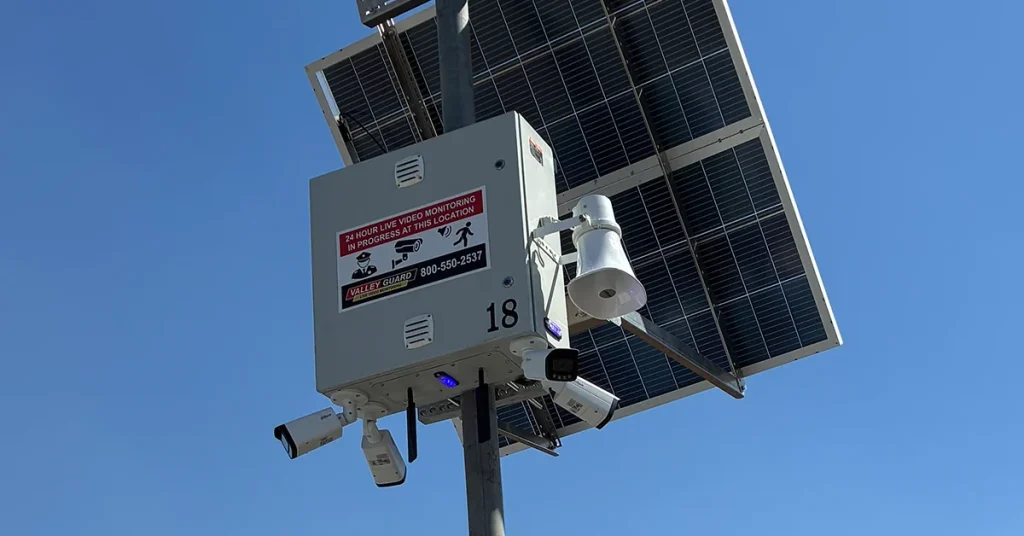
A commercial solar pole-mounted camera unit is a self-contained system. The solar panel charges an onboard battery that powers the camera and the cellular LTE uplink.
There's no grid connection, no WiFi dependency, and no conduit run. The unit mounts to any pole, wall, or structural surface using standard hardware.
For a surface parking lot, that means any existing light pole is a potential camera position. The back row. The overflow section.
The entry gate 200 feet from the nearest building. Positions that were previously off the table because of the wiring cost become viable in an afternoon.
Valley Alarm deploys solar pole-mounted cameras at Los Angeles-area parking lots with no trenching, no permit timeline, and no asphalt disruption. Units are operational within 48 hours of a site walk.
The deployment process starts with a site walk. Valley Alarm reviews the lot layout, identifies the coverage gaps, and selects mount positions.
Within 48 hours of that walk, the units are installed and live. No electrician coordination. No permit wait. No asphalt work.
For an overview of how solar pole-mounted cameras work across every commercial property type, see the full guide: Commercial Security Without Wiring.
Live Monitoring Is What Changes the Outcome
A solar camera that records but isn't monitored is still just evidence collection. It tells you what happened. It doesn't stop anything.
Valley Alarm's solar pole-mounted cameras connect to ValleyGuard, Valley Alarm's live remote video monitoring service. When the camera detects motion during a monitored period, the event triggers a review by a US-based Intervention Specialist watching the live feed.
If the activity appears to be a threat, the Specialist issues an audio warning directly to the site via the unit's speaker. In most cases, that warning is enough to end the incident before any theft or damage occurs.
If the subject doesn't respond to the warning, the Specialist contacts law enforcement and provides a real-time description. Police are responding to a confirmed active incident, not a recorded one from hours earlier.
ValleyGuard Intervention Specialists have logged 1,042 confirmed audio deterrence outcomes across monitored sites in California. At a business park in Reseda, a white sedan and an individual loitering in the parking lot prompted multiple audio warnings from a ValleyGuard Intervention Specialist.
The individual didn't leave. LAPD was contacted, and a patrol unit was dispatched. At a commercial property in Van Nuys with an outdoor rear lot, ValleyGuard detected movement in the back lot area at 12:37 am on a Thursday morning. LAPD was notified, and a patrol was sent. Neither of those incidents ended with a loss.
For lots that need temporary coverage during a transitional period, Valley Alarm's mobile surveillance trailers are a fast-deploy alternative.
A solar trailer repositions as needed. A solar pole unit covers a fixed perimeter position permanently. Both connect to ValleyGuard.
Which Parking Lots Benefit Most
Solar pole cameras are particularly well-suited to a few common parking lot scenarios in the Greater Los Angeles area.
Surface lots with no existing camera infrastructure are the most straightforward case. There's no hardwired system to integrate with and no existing coverage plan to work around.
You're starting from scratch, and solar pole cameras can cover the full perimeter without running a single conduit.
Lots with partial coverage are just as common. A property might have cameras on the building's faces but nothing that reaches the lot beyond the first two rows.
That's where most thefts actually happen. Solar pole cameras fill those gaps without touching what's already installed.
Overflow and satellite lots are a third scenario. Car dealerships, logistics companies, and commercial property managers often run surface lots that aren't attached to their main facility.
There's no building to mount to, no infrastructure to tie into. Solar pole cameras cover those sites as standalone deployments. They don't need anything on-site to work.
Frequently Asked Questions
Do solar security cameras work reliably in Los Angeles weather?
Yes. Commercial solar security cameras are designed with battery reserves that carry the unit through multiple cloudy days without recharging. Los Angeles averages over 280 sunny days per year, which means most units consistently recharge.
June Gloom and marine layer conditions do reduce charging hours, but the battery capacity on commercial-grade units is sized for those stretches. Consumer solar cameras don't have the same buffer, which is one reason they underperform in commercial settings.
Can solar cameras mount to existing light poles in a parking lot?
Yes. Solar pole-mounted camera units use standard pole clamps and mounting brackets that work on round or square light poles. No drilling, no conduit taps, and no electrical connection to the existing pole circuit is needed.
The unit is entirely self-contained. Most mount positions in a standard parking lot can be set up in under an hour once the site walk is done and hardware is on-site.
What happens when a solar camera detects activity in the parking lot?
When a ValleyGuard-connected solar camera detects motion during a monitored window, the event goes to a live review queue. A US-based Intervention Specialist watches the feed, assesses the situation, and responds.
If the activity appears to be a threat, they issue an audio warning through the unit's onboard speaker. If the subject doesn't respond, the Specialist contacts law enforcement and provides a live description of the suspect and vehicle. This is active intervention, not passive recording.
How long does it take to install solar cameras on a parking lot?
Valley Alarm can complete a site walk and have solar pole-mounted cameras operational within 48 hours. There's no permit required, no electrical contractor to schedule, and no asphalt work involved.
The speed of deployment is one of the main reasons property managers choose solar pole cameras over hardwired systems when coverage gaps need to be addressed quickly.
Are solar parking lot cameras a good fit for overnight monitoring?
Yes, and that's exactly when they matter most. Catalytic converter thefts and vehicle break-ins in parking lots occur predominantly during overnight and early-morning hours, when there's no staff on-site. ValleyGuard monitoring covers those windows.
The cameras use night-color imaging, so footage quality holds up after dark. An Intervention Specialist monitoring the lot at 2 am can issue an audio warning before a theft is completed. That's a different outcome than reviewing footage the following morning.
What's the difference between a solar trailer and a solar pole-mounted camera for parking lot coverage?
A solar surveillance trailer is a large, mobile unit on wheels that deploys rapidly and can be repositioned as needed. It's a strong option for temporary coverage or sites that change frequently.
A solar pole-mounted camera is a fixed, low-profile unit that mounts permanently on a pole, wall, or other structural surface.
For parking lots where coverage gaps are at consistent positions, pole-mounted cameras cover those specific points without the trailer footprint. Both connect to ValleyGuard live monitoring.
Parking lot coverage gaps don't close on their own.
If your lot has areas that cameras can't reach due to power limitations, Valley Alarm can walk the site and show you exactly where solar pole-mounted units would go. No trenching, no permit wait, no electrician.
Related Articles
- →Commercial Security Without Wiring: The Complete Guide
- →Valley Alarm Solar Pole-Mounted Camera Service
- →Solar Security Cameras for Logistics Yards
- →ValleyGuard Catches on Camera
- →Valley Alarm Mobile Surveillance Trailers
- →How ValleyGuard Stops Construction Theft
- →Construction Site Security Guide for Los Angeles
- →Solar Security Cameras for Car Dealerships in Los Angeles
- →Solar Security Cameras for Vacant Properties in Los Angeles
- →Solar Security Cameras for Warehouses and Industrial Yards in Los Angeles

- Remote Video Monitoring: The Complete Guide for Commercial Properties - August 13, 2026
- How Much Does Remote Video Monitoring Cost? - August 13, 2026
- Remote Video Monitoring for Apartment Complexes and Multi-Family Properties - August 13, 2026