
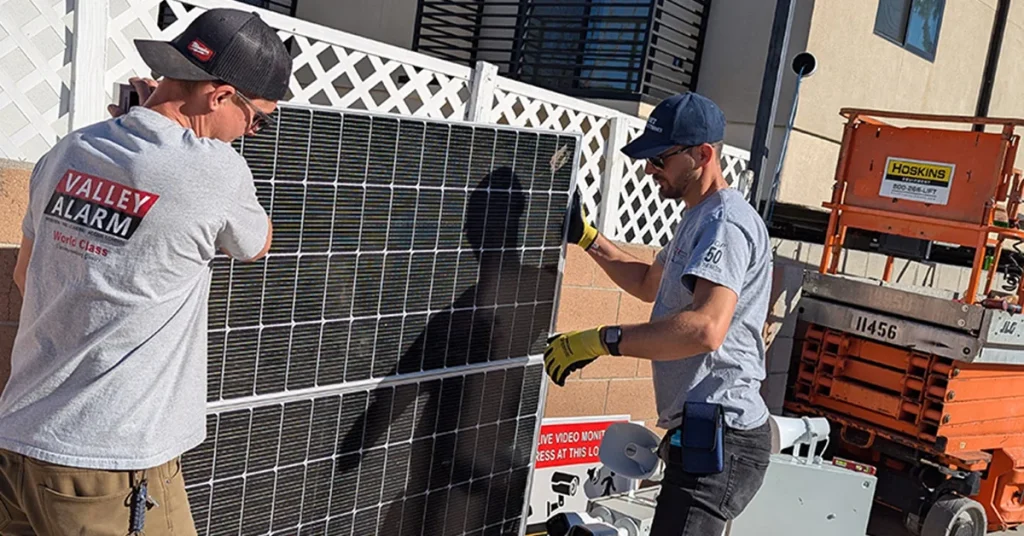
Not Every Camera Fits Every Property
You have a spot that needs a camera. It might be the back corner of a yard, an overflow lot three blocks from your main building, or a fence line 200 feet from the nearest power outlet.
The question isn't whether you need coverage there. It's which type of camera actually works for that specific location.
Most commercial buyers researching solar cameras hit a wall with hardwired ones first. The power run doesn't reach. The permit timeline is too long. The location changes seasonally.
And somewhere in that research, they find two distinct solar products on the market with different use cases that are often lumped together.
For Los Angeles commercial properties that need perimeter coverage at fixed points such as entry gates, yard perimeters, and loading docks, solar-powered pole-mounted cameras provide a permanent solution without the need for electrical infrastructure.
This post covers all three options in honest terms. Valley Alarm offers solar pole-mounted cameras, mobile surveillance trailers, and hardwired CCTV installations.
The right product depends on what's actually true about the location. The goal here is to help you figure that out before you call.
Jump to: Solar pole cameras | Hardwired CCTV | Surveillance trailers | Side by side | What they share
Option 1: Solar Pole-Mounted Cameras
A solar pole-mounted camera is a self-contained unit. It has its own solar panel, battery pack, AI camera, and built-in LTE cellular uplink. There's no connection to on-site power.
There's no Wi-Fi dependency. It mounts to any existing pole, wall, or structural surface and connects directly to ValleyGuard live monitoring over cellular.
Valley Alarm can complete a site walk and have a unit monitoring live within 48 hours. No electrician. No permit. No trenching.
When a solar pole camera is the right choice
Solar pole cameras are the right fit when you need coverage at a fixed location without power access, and that location isn't going to change.
Overflow lots, perimeter fencing, loading docks, entry gates, yards with lighting poles but no camera runs, and secondary properties that aren't worth a full electrical buildout are all solar pole camera applications.
They also work well as a fast-deploy first layer while you're waiting for a hardwired installation to be permitted and scheduled.
Up in 48 hours, monitoring live, and they can stay permanently once they're in position.
Where solar pole cameras don't fit
A solar pole camera is a fixed unit. Once it's mounted, that's where it lives. If you're managing a construction site where the coverage footprint changes every few weeks, you'll be remounting constantly. That's the wrong tool for that job. A trailer is.
Also worth knowing: in LA County, June Gloom and May Grey can run for weeks. Commercial-grade units are built with multi-day battery reserves for exactly that reason. Consumer solar cameras aren't.
That's why consumer units go offline after a cloudy weekend, and commercial units don't.
Option 2: Hardwired CCTV
Hardwired cameras run on building power through conduit. They're the standard for any covered parking structure, warehouse interior, retail storefront, or building perimeter that already has electrical access. No battery cycles, no weather variability, no cellular dependency.
The limitations are exactly what they sound like. Running new conduit to a camera position requires an electrician, a permit, and potentially asphalt or concrete work if you're crossing a surface.
For most building-mounted positions, the infrastructure is already in place. The back corner of a 5-acre yard is a significant project.
When hardwired cameras are the right choice
If your property has electrical infrastructure and the camera positions are permanent, hardwired is the right call.
Building interiors, covered parking, retail storefronts, and any exterior wall position with accessible power are all hardwired territory.
You're not fighting battery cycles or solar panel angles. The cameras draw power from the building and run indefinitely.
Where hardwired cameras don't fit
Any location where the conduit run is cost-prohibitive or logistically impractical. Remote fencing, secondary lots, construction sites, vacant properties with no active service, and outdoor areas far from the building footprint are all solar territory.
That's not a limitation of hardwired cameras. It's just where the economics stop making sense.
Option 3: Solar Surveillance Trailers
A solar surveillance trailer is a large, wheeled unit with an elevated camera mast, solar panels, and battery storage. It deploys in 24 to 48 hours, connects to ValleyGuard monitoring over cellular, and repositions as your coverage needs change.
Valley Alarm's mobile surveillance trailers cover construction sites, temporary staging areas, events, and any scenario where the footprint isn't fixed.
The trailer's visible tower is part of the deterrence strategy. It's a presence statement. Anyone pulling into a lot or walking a perimeter sees it. That's intentional.
When a trailer is the right choice
Construction sites are the clearest fit. The coverage footprint on an active job site changes as the build progresses.
You need cameras near the material staging area in week one, near the mechanical room in month three, and near the finished units in month six. A trailer repositions for each phase. A pole camera doesn't.
Temporary staging areas, auction inventory lots, outdoor events, and any coverage scenario in which the location changes within the next 90 days are trailer applications. If you need to move it, the trailer is the right tool.
Where trailers don't fit
A trailer needs space to sit. It's large, it takes up footprint, and it's more visible than a pole unit. For a permanent perimeter position at a fixed commercial property, a solar-powered pole camera is lower-profile and the better long-term fit. Trailers aren't designed to be permanent fixtures.
Side by Side
For commercial buyers comparing all three options at once, here's the practical breakdown:
| Factor | Solar Pole Camera | Hardwired CCTV | Solar Trailer |
|---|---|---|---|
| Infrastructure needed | None. Self-contained unit. | Conduit, electrician, and permit required | None. Self-contained trailer. |
| Deployment time | 24-48 hrs from site walk | Weeks (permit + electrician + install) | 24-48 hrs from site walk |
| Repositionable? | No. Semi-permanent mount. | No. Permanent installation. | Yes. Wheels. Reposition as needed. |
| Best fit | Fixed perimeter points, overflow lots, yards without power runs | Building interiors and perimeters with existing power access | Construction sites, temp lots, events, anywhere coverage moves |
| Live monitoring | ValleyGuard (24/7, US-based) | ValleyGuard (24/7, US-based) | ValleyGuard (24/7, US-based) |
| Weather dependency | Solar with multi-day battery buffer for overcast periods | None. Runs on building power. | Solar with larger panel and battery capacity than pole unit |
For the full picture on commercial surveillance without running new wiring, see the complete guide: Commercial Security Without Wiring.
What All Three Have in Common
The camera hardware is the input. ValleyGuard is the output.
Whether it's a pole unit on a vacant lot, a hardwired unit inside a distribution center, or a trailer unit on a construction site, when motion is detected within a monitored window, the event is routed to a ValleyGuard Intervention Specialist.
A real person reviews the live feed and makes a call. If it's a confirmed threat, they issue a live audio warning via the on-site speaker system. If the subject doesn't respond, they contact law enforcement with a real-time description and a live feed.
That's the same process regardless of which camera type triggered it. Passive recording systems document what happened. ValleyGuard responds while it's still happening.
A manufacturing facility in Rancho Cucamonga has had more than 150 incidents logged by ValleyGuard across the site, resulting in 26 law enforcement dispatches.
The monitoring process is the same at every event: a Specialist reviews the live feed, issues a verbal warning if the activity is a confirmed threat, and contacts law enforcement if needed.
That's not a function of the camera type. It's a function of who's watching.
Construction companies operating across multiple Greater Los Angeles job sites often use mobile surveillance trailers for rapid repositioning and solar pole cameras for fixed perimeter coverage.
Valley Alarm has logged more than 7,763 ValleyGuard incidents across 58 California cities, with more than 5,363 confirmed audio deterrence outcomes. See documented interventions at ValleyGuard catches on camera.
Frequently Asked Questions
What's the difference between a solar pole camera and a solar surveillance trailer?
A solar pole camera is a compact, fixed-mount unit. It mounts on any existing pole or surface, stays in place, and permanently covers a specific perimeter position.
A solar surveillance trailer is a large, wheeled unit that deploys rapidly and can be repositioned as coverage needs change. Pole cameras are the right fit for fixed locations.
Trailers are the right fit for job sites and temporary scenarios where the footprint moves. Both connect to ValleyGuard live monitoring.
Do solar security cameras work during LA's marine layer season?
Commercial-grade solar cameras are built with multi-day battery reserves specifically because Southern California's marine layer season runs for weeks at a time. Consumer solar cameras don't have that reserve, which is why they go offline after a cloudy weekend.
Commercial units from Valley Alarm are sized for continuous monitoring through extended overcast periods.
Can all three camera types connect to the same monitoring service?
Yes. Valley Alarm's solar pole cameras, mobile surveillance trailers, and hardwired CCTV installations all connect to ValleyGuard, the same 24/7 US-based monitoring center. Intervention Specialists monitor all camera types from a single platform.
A property with hardwired cameras on the building and solar pole cameras on the perimeter can have both monitored under a single account, without separate contracts.
How quickly can Valley Alarm deploy solar cameras?
Both solar pole cameras and mobile surveillance trailers deploy within 24 to 48 hours of a site walk. No permit, no electrical contractor, and no conduit work required.
Hardwired CCTV installs take longer because they involve permitting and an electrician, but Valley Alarm manages the full installation process in either case.
When does hardwired CCTV make more sense than solar?
Hardwired is the right call when the camera position already has electrical infrastructure and the installation is permanent. Building interiors, covered parking structures, and retail storefronts with accessible power runs are hardwired applications.
If the power is already there and the position isn't going to change, hardwired cameras are the more reliable long-term option.
Can Valley Alarm mix camera types at the same property?
Yes. Many commercial properties use a combination. Hardwired cameras cover the building interior and perimeter where power is accessible. Solar pole cameras cover the overflow lot, back fence line, or remote yard area where it isn't.
A single ValleyGuard account monitors all of them together. Valley Alarm walks the site and recommends the right mix based on the actual coverage gaps.
Not sure which camera type is best for your property?
Valley Alarm walks the site, identifies the coverage gaps, and recommends the right mix. Solar pole cameras, trailers, and hardwired CCTV all connect to ValleyGuard live monitoring.
Related Articles
- →Commercial Security Without Wiring: The Complete Guide
- →Valley Alarm Solar Pole-Mounted Camera Service
- →Valley Alarm Mobile Surveillance Trailers
- →How Solar Pole-Mounted Security Cameras Work
- →Solar Security Cameras for Parking Lots in Los Angeles
- →Solar Security Cameras for Logistics Yards
- →ValleyGuard Catches on Camera
- →Solar Security Cameras for Car Dealerships in Los Angeles
- →Solar Security Cameras for Warehouses and Industrial Yards in Los Angeles

- Remote Video Monitoring: The Complete Guide for Commercial Properties - August 13, 2026
- How Much Does Remote Video Monitoring Cost? - August 13, 2026
- Remote Video Monitoring for Apartment Complexes and Multi-Family Properties - August 13, 2026