
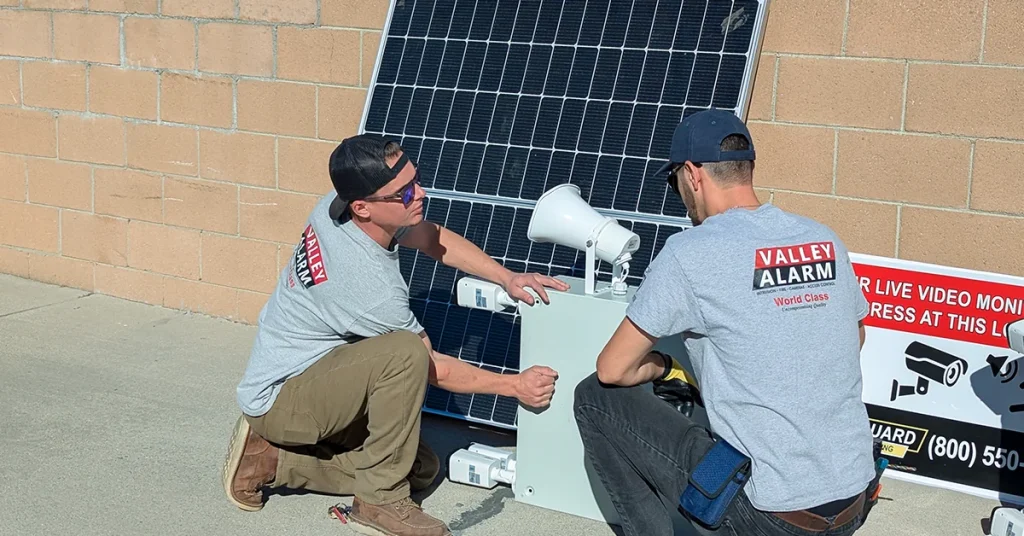
Five Components. No Wire. Someone Watching.
A solar pole-mounted security camera doesn't look complicated from the outside. It's a compact unit on a pole.
But commercial buyers evaluating it as a serious security solution usually want to understand what's actually inside it, how it stays online, and what happens on the back end when it detects something.
This post covers all of that. Not as a product spec sheet, but as a practical explanation of how the system works from the moment sunlight hits the panel to the moment a Valley Alarm Intervention Specialist is talking to an intruder on a Pomona lot at 2 am.
Solar pole-mounted security cameras deployed at commercial properties across Greater Los Angeles operate as fully self-contained units: a solar panel, an onboard battery, an AI camera, and a cellular LTE uplink connect directly to ValleyGuard live monitoring without Wi-Fi, hardwired power, or on-site network infrastructure.
For the commercial buyer who wants coverage at a location without power infrastructure, this architecture explains why that's no longer a blocker.
For the full picture of how it fits into a broader no-wire security strategy, see the complete guide: Commercial Security Without Wiring.
Jump to: The five components | Deployment | When a camera triggers | What it isn't
The Five Components
Every solar pole-mounted camera unit Valley Alarm deploys has five working parts. They function as a single system. Take any one out and the unit doesn't work the way it needs to.
1. The Solar Panel
The panel faces the sky and converts sunlight into electrical current. It's sized for commercial outdoor use, not residential.
That distinction matters in Southern California where June Gloom and May Grey can run for weeks at a stretch.
A residential solar camera has a small panel built for a sunny backyard. A commercial unit has a panel sized to maintain battery charging through extended marine-layer seasons.
Panel placement is part of the site walk. Valley Alarm looks at the mounting position, the direction the panel will face, and what will cast shade across it throughout the day. A panel aimed in the wrong direction charges poorly. That's a positioning decision, not a hardware limitation.
2. The Battery
The battery stores what the panel collects and powers the camera, cellular radio, and speaker through the night and through overcast periods. It's the component that makes continuous 24/7 monitoring possible without a power line.
Commercial units carry enough reserve to run through multiple consecutive days without a meaningful charge.
Consumer solar cameras don't. That's the gap between a camera that goes offline after a cloudy weekend and one that's still live on Monday morning when your lot got hit Saturday night.
3. The AI Camera
The camera watches. But it doesn't send every pixel of video to a monitoring center around the clock. That would overwhelm the cellular connection and generate far more review time than any monitoring team could handle.
Instead, the camera uses onboard AI to decide what's worth flagging. It distinguishes between a car driving past and a person walking through the frame. It filters out ambient movement like wind in trees or a passing shadow.
When it identifies an event worth human review, it sends it to the ValleyGuard monitoring center. What gets reviewed is a relevant clip, not a continuous stream of nothing happening.
4. The Cellular LTE Uplink
The cellular radio enables the unit to operate independently of on-site network infrastructure. There's no Wi-Fi dependency. No on-site router. No IT configuration.
The unit connects to a cellular network the same way a phone does, and it transmits event clips and live feed access over that connection.
This matters more than it might seem. Wi-Fi-dependent cameras can be knocked offline by cutting the internet at the panel or the router.
A cellular uplink can't be defeated that way. For properties where the communications infrastructure is part of the threat model, cellular is the right architecture.
5. The On-Site Speaker
The speaker is what turns the unit from a recording device into an active deterrent. When a ValleyGuard Intervention Specialist reviews a live event and determines it's a confirmed threat, they issue a verbal warning directly through the unit's speaker.
The person on the lot hears a live human voice telling them they're being watched and that law enforcement is being contacted.
That's not a recorded message. It's a real person talking in real time.
How Deployment Works
The unit's self-containment is what makes deployment fast. Valley Alarm doesn't need an electrician, a permit, or a trenching crew.
Site walk
Valley Alarm walks the property with the client. The goal is to identify which locations need coverage, which existing poles or structures can support a mount, and where the solar panel will receive adequate exposure.
For most commercial properties, this takes an hour or less. Multi-site deployments get mapped in a single visit where possible.
Placement planning
Camera position and panel angle both get confirmed before a single bracket goes up. The camera needs a clear line of sight to the area it's covering.
The panel needs a clear exposure to the sky. On a lighting pole, the panel typically mounts above the camera housing and faces south. Valley Alarm handles the placement math so the unit performs the way it should from day one.
Installation
The unit mounts to the pole with standard brackets. No electrical connection to the pole's circuit. No conduit run. No penetration into the structure. The mounting hardware is the entire installation. For most single-unit deployments, it's a same-day process.
Live on ValleyGuard
Once the unit is mounted and powered up, it connects to the ValleyGuard monitoring center over cellular. Valley Alarm confirms the connection, verifies the camera's field of view, and sets the monitoring parameters for that site. From that point, Intervention Specialists are watching. The typical window from site walk to live monitoring is 24 to 48 hours.
What Happens When the Camera Detects Something
This is the part that matters most for a buyer evaluating whether this is a real security solution or just a recording device.
When the camera's onboard AI flags activity during a monitored window, it pushes the event to the ValleyGuard monitoring center.
A live Intervention Specialist pulls up the feed and reviews what triggered it. They're looking at real-time video, not a saved clip that's already 20 minutes old.
If the activity is benign, they dismiss it and move on. If it's a confirmed threat, they go active immediately. The speaker on the unit broadcasts a live verbal warning.
If the subject doesn't respond and leave, the Specialist contacts law enforcement and provides a real-time description of the individual, what they're doing, and the camera feed they're watching.
ValleyGuard Intervention Specialists monitoring commercial properties across California reviewed more than 6,600 incidents in 58 cities and issued live audio warnings during more than 1,042 confirmed threat events.
A manufacturing facility in Rancho Cucamonga monitored by ValleyGuard has had more than 150 incidents reviewed across the site, resulting in 26 law enforcement dispatches.
Each of those dispatches started the same way: a camera flagged activity, a Specialist reviewed the feed, confirmed a threat, issued a warning, and called it in. The camera didn't stop the threat. The person watching the camera did.
See documented ValleyGuard interventions in ValleyGuard catches on camera(opens in new tab)(opens in new tab).
What This System Is Not
It's worth being direct about what solar pole-mounted cameras don't do, because some buyers come in expecting a different product.
It's not a consumer camera. Arlo, Ring, and Reolink are designed for residential use and residential budgets. They have small panels, limited battery capacity, and no professional monitoring.
When they go offline during a cloudy stretch or a power outage, no one calls you. When they record something, no one responds. That's a different product category entirely.
It's not a passive recorder. The unit doesn't just store footage for you to review after a loss. ValleyGuard monitoring means someone is watching while events are happening, not after. The goal is intervention before the theft is completed, not documentation of it afterward.
And it's not the right fit for every coverage scenario. If your location needs to move every few weeks, a mobile surveillance trailer is a better fit.
If the coverage spot already has power access and you want a permanent installation, hardwired CCTV is the right call. Valley Alarm offers all three and recommends based on what's actually true about the location.
See a full comparison at Solar vs. Wired Security Cameras for Commercial Properties.
Frequently Asked Questions
How does a solar pole-mounted camera stay online when there's no sunlight?
The onboard battery stores energy collected during daylight hours and powers the unit through the night and through overcast periods.
Commercial-grade units are built with enough reserve to maintain continuous monitoring through multiple consecutive days without a meaningful charge. That's why they don't go offline during LA's marine layer season, as consumer solar cameras do.
Does the camera require Wi-Fi or an on-site internet connection?
No. The unit transmits over cellular LTE, the same network infrastructure mobile phones use. There's no Wi-Fi dependency and no on-site router or network configuration required.
The unit works wherever there's cellular coverage, including remote lots, vacant properties, and secondary sites with no communications infrastructure.
What does "AI camera" mean in practice?
The camera uses onboard processing to evaluate what it sees before deciding whether to send an alert.
It filters out ambient movement, such as passing vehicles, swaying vegetation, and shifting shadows, and flags activity that appears to be a person moving through the frame during a monitored window.
The goal is sending relevant events to a human reviewer, not a continuous stream of noise.
How long does it take to deploy a solar pole camera?
Valley Alarm can complete a site walk and have a unit live on ValleyGuard monitoring within 24 to 48 hours.
No permit is required, no electrical contractor needs to be scheduled, and there's no conduit or trenching work involved.
The installation hardware mounts directly to the pole with standard brackets, and the unit is operational once it's powered up and connected.
What happens when a ValleyGuard Specialist sees something on the feed?
The Specialist reviews the live feed in real time. If the activity is benign, they dismiss it. If it's a confirmed threat, they issue a live verbal warning immediately over the on-site speaker.
If the subject doesn't respond, they contact law enforcement and provide a real-time description of the individual and what's happening on the feed. The entire sequence happens while the event is still in progress, not after the fact.
Can Valley Alarm deploy these cameras on any type of pole or surface?
Yes. The mounting hardware accommodates round and square poles, concrete pillars, wood utility poles, and structural walls. No electrical connection to the existing structure is required.
Valley Alarm has deployed units on lighting poles at commercial lots, galvanized steel industrial poles at yard perimeters, and concrete pillars with no power access at all. The site walk determines the right mount position for each location.
Ready to see how this works at your property?
Valley Alarm walks the site, plans the camera positions, and has solar pole-mounted units live on ValleyGuard monitoring within 48 hours. No permit, no electrician, no conduit.
Related Articles
- →Commercial Security Without Wiring: The Complete Guide
- →Valley Alarm Solar Pole-Mounted Camera Service
- →Solar vs. Wired Security Cameras for Commercial Properties
- →Valley Alarm Mobile Surveillance Trailers
- →Solar Security Cameras for Parking Lots in Los Angeles
- →ValleyGuard Catches on Camera
- →Solar Security Cameras for Logistics Yards
- →Solar Security Cameras for Vacant Properties in Los Angeles

- Remote Video Monitoring: The Complete Guide for Commercial Properties - August 13, 2026
- How Much Does Remote Video Monitoring Cost? - August 13, 2026
- Remote Video Monitoring for Apartment Complexes and Multi-Family Properties - August 13, 2026