
How to Protect Every Corner of Your Commercial Property Without Running a Single Wire
There's always a spot that doesn't get covered.
Sometimes it's an overflow lot two hundred feet from the nearest electrical panel. Sometimes it's the back corner of a fenced yard where running conduit would mean cutting through asphalt, pulling a permit, and waiting weeks for an electrician. Sometimes it's a vacant parcel with no power at all. And sometimes it's a perimeter gate at a construction site that won't have utility service until the build is nearly done.
Hardwired cameras solve many problems. Infrastructure-free coverage isn't one of them. Solar-powered video surveillance is built for exactly the spots a wired system can't reach.
A solar pole-mounted security camera runs on a self-contained panel and battery, transmits over cellular LTE without touching your network, and mounts to almost any structure you can point a camera from. It's operational within 24 to 48 hours of a site walk. And every camera connects directly to ValleyGuard, Valley Alarm's 24/7 live monitoring center, where US-based Intervention Specialists respond to events in real time.
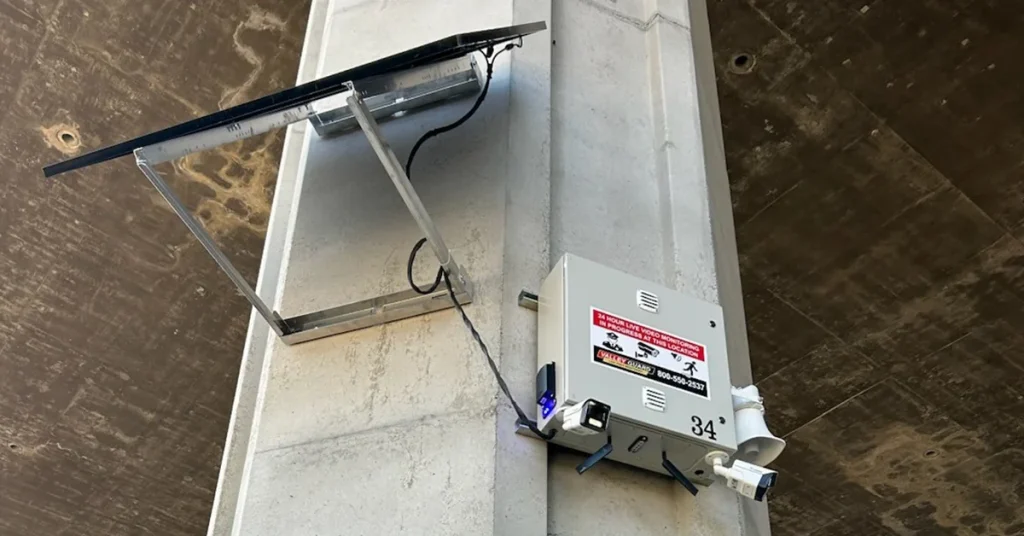
Solar pole-mounted security cameras deployed at commercial properties across Greater Los Angeles operate as fully self-contained units: a solar panel, an onboard battery, an AI camera, and a cellular LTE uplink connect directly to ValleyGuard live monitoring without Wi-Fi, hardwired power, or on-site network infrastructure.
Jump to: The coverage gap | What they are | What ValleyGuard does | Who needs them | When a trailer fits better
The Coverage Gap Hardwired Camera Systems Leave Behind
Most commercial security systems are designed around building infrastructure. Cameras run on building power. They connect through building networks. They mount to building walls. That works for everything within reach of that infrastructure.
Beyond the building, coverage gets expensive fast.
Running conduit to a perimeter camera 150 feet from the nearest panel can cost thousands before a single camera goes up. Trenching through a parking lot adds permit timelines, asphalt restoration, and contractor coordination that can stretch a simple camera install into a weeks-long project. For a back gate, a far corner of a fenced yard, or a vacant parcel with no active utility service, the math just doesn't work.
So those spots don't get covered. And the timing isn't random. According to ValleyGuard incident data, 65.8% of incidents happen outside business hours, before 9 am or after 6 pm, when the building is closed and the edges of the property are empty.
The result: businesses with complete hardwired systems on their buildings still have blind spots at the edges of their property. Catalytic converter theft in surface lots. Equipment theft at construction perimeters. Vandalism at vacant parcels between tenants. Cargo theft at the far corner of an industrial yard. The incidents don't happen in front of the camera. They happen in the gap the camera doesn't reach.
Solar-powered surveillance cameras are built for that gap.
What Solar Pole-Mounted Security Cameras Are (and Aren't)
A solar pole-mounted security camera is a self-contained surveillance unit. Solar panel. Battery. Commercial-grade AI camera. Cellular LTE transmitter. It doesn't need building power. It doesn't need your network. It doesn't need conduit, trenching, or an electrician.
The unit mounts to a pole, a wall, a concrete pillar, or most fixed structures from which a camera can be pointed. Valley Alarm has deployed these units on wooden utility poles, construction-site walls, industrial-yard fencing, and concrete freeway overpass pillars where there's no power access at all. The freeway overpass deployment is the clearest illustration of what "infrastructure-free" actually means. A concrete pillar under the freeway has no power within reach, no network, and no practical way to run a hardwired camera to it. The solar pole unit goes up anyway, and ValleyGuard is monitoring it within 48 hours.
That cellular LTE connection is what separates a commercial off-grid security camera from a consumer product. Consumer solar cameras like Reolink, Arlo, and Vosker depend on your wifi to transmit. A weekend of cloud cover drains the battery. Or the wifi goes down. The camera goes dark, and you don't find out until you check, which might be Monday morning, after something already happened. Commercial solar pole units use dedicated cellular connections that are entirely independent of your site infrastructure. They don't go down when your wifi does, and they don't go dark when it's overcast for three days. If you want the full component-by-component breakdown, from panel sizing to battery buffer to the cellular uplink, see how solar pole-mounted security cameras work.
These aren't cameras you buy off a shelf and install yourself. Valley Alarm conducts a site walk first, determines the placement for optimal coverage and solar exposure, handles the full installation, and connects each unit to ValleyGuard before leaving the property.
What ValleyGuard Does When a Camera Triggers
Hardware is the first part. A camera that records what happened is not the same as a system that stops what's happening.
ValleyGuard is Valley Alarm's 24/7 live monitoring center. US-based Intervention Specialists watch camera feeds in real time. When a solar pole unit triggers, a specialist reviews that feed within seconds. Not a recorded alert. Not an app notification. A person watching what's actually happening at your property.
If there's a confirmed threat, the Intervention Specialist issues an audio warning directly through the camera's on-site speaker. A real voice, from a real person, telling whoever is on your property that they're being watched and law enforcement is being contacted. That's active intervention while the incident is still in progress, not a notification that arrives after it's over.
According to ValleyGuard incident data, 98% of monitored incidents are resolved with a live audio warning alone before the situation escalates to theft, vandalism, or a police response.
The audio warning does most of the work. When it doesn't, the Intervention Specialist contacts law enforcement directly and stays on the feed, providing real-time information to responding officers. That happens in 723 cases on record, about 11.9% of incidents. The other 88.1% never get that far, because someone interrupted them live.
The timing data tells you when that response matters most. According to ValleyGuard incident data, the 5am to 9am dawn window is the single highest-risk period, accounting for 33.6% of all incidents. Saturday is the highest-risk day of the week at 19.5%, and weekends together account for 35.8% of everything logged. These are the hours a hardwired system at the building is recording an empty lobby while the activity happens out at the fence line.
Across the full monitoring record: 6,086 verified incidents across 57 cities in Greater Los Angeles and the surrounding counties. These are live-response events, not system notifications. Cases where a person on a live feed made a decision that changed what happened on a property that night.
The Properties That Need Solar Pole Cameras Most
Solar pole-mounted cameras aren't right for every security situation. They work best where hardwired cameras are impractical and the coverage gap is fixed in one place.
Surface Parking Lots
Surface lots have lighting poles but almost never have accessible power runs for cameras. Trenching across asphalt to reach a position at the back of a lot isn't a cost-effective upgrade. It's a construction project. Solar pole cameras mount to existing lighting infrastructure with no electrical work and go live within 48 hours.
Catalytic converter theft has surged across Los Angeles County. Surface lots are primary targets: vehicles parked overnight, minimal foot traffic, limited coverage at the perimeter where hardwired cameras don't reach. ValleyGuard live monitoring changes the timeline from a police report filed the next morning to an audio warning issued while the theft is still in progress. See the full guide: solar security cameras for parking lots in Los Angeles.
Construction Sites
Construction sites don't have final utility service until late in the build. Early and mid-phase sites have temporary power for tools, not for permanent camera infrastructure. Solar pole cameras deploy during any phase, on walls, framing, or site structures, without waiting for service to be established.
The risk concentrates exactly when the site is empty. According to ValleyGuard incident data, the 5am to 9am dawn window is the highest-risk period of the day, and weekends carry 35.8% of all incidents. That's the gap between the last worker leaving and the first one arriving. See the full guide: solar security cameras for construction sites in Los Angeles.
Car Dealerships
Main dealership lots usually run on building power. Satellite lots, overflow inventory, and off-site storage are a different situation: lighting infrastructure, but no structured power runs for cameras. Those secondary lots are where catalytic converter theft, wheel theft, and vehicle break-ins concentrate.
This is the most heavily monitored site type in the ValleyGuard record. According to ValleyGuard incident data, one auto dealer group in the San Fernando Valley accounts for 467 logged incidents, with 93% of them deterred by audio warning alone. Solar pole cameras cover overflow and satellite positions without any electrical buildout. See the full guide: solar security cameras for car dealerships in Los Angeles.
Vacant and Transitional Commercial Properties
Vacant commercial parcels have no active power at all. No building infrastructure. No network. No structure to mount a hardwired system on. Solar pole cameras are, in many cases, the only viable surveillance option for these properties.
Property management companies overseeing vacant or transitional commercial sites across Los Angeles, the Inland Empire, and Ventura County use solar-powered surveillance cameras because they require no electrical infrastructure and can be redeployed as the property changes hands.
This is where the most exposure lives. According to ValleyGuard incident data, vacant and between-tenant properties account for more than 40% of all incidents. Repeat trespassing, illegal dumping, vandalism, and copper theft are the common patterns. The goal isn't recording what happened. It's keeping it from happening. See the full guide: solar security cameras for vacant properties in Los Angeles.
Warehouses and Industrial Yards
Warehouse perimeters along the Inland Empire logistics corridor and across Greater Los Angeles can run hundreds of feet. The far corners of a large fenced yard, loading areas, secondary gates, and back fencing are often 150 to 200 feet from any accessible building power. Running conduit to those positions can cost more than the camera system itself.
Solar pole cameras cover those corners without the infrastructure cost. According to CargoNet, the average cargo theft loss per incident in California reached $273,990 in 2025, and the perimeter positions farthest from existing building cameras are where that exposure sits. See the full guide: solar security cameras for warehouses and industrial yards in Los Angeles.
Logistics Yards and Cargo Facilities
Truck yards, drayage lots, and intermodal facilities have the same problem as warehouses, scaled up. Acres of fenced perimeter, container stacks that block sightlines, and gate positions far from any structured power. The cargo sitting in those yards overnight is the target, and the perimeter is where it's lost.
Solar pole cameras cover gate and fence-line positions across a large yard without trenching the whole footprint for conduit. See the breakdown: solar security cameras for logistics yards and cargo facilities.
Cannabis Facilities
California cannabis operators under CalCannabis compliance need continuous camera coverage of the full perimeter, including outdoor cultivation areas and remote perimeter points. Those positions frequently have no power infrastructure. The building power serves the structure, not the edges of an outdoor grow.
Solar pole cameras satisfy the perimeter coverage requirement at positions where electrical buildout isn't practical. Every camera connects to ValleyGuard's monitoring center, providing the continuous 24/7 oversight compliance frameworks expect without running power to every corner of the property. See the full guide: solar security cameras for cannabis facilities in California.
When a Trailer or a Guard Fits Better
Solar pole cameras are the right tool when the coverage gap stays in one place. Two other options solve different problems, and it's worth knowing where the line is before you schedule a site walk.
A solar-powered mobile security trailer is the better fit when the risk moves week to week. It's a wheeled unit with an elevated camera mast that deploys in 24 to 48 hours, runs on its own solar and battery power, connects to the same ValleyGuard monitoring, and repositions as job sites or staging areas shift. If your coverage needs aren't fixed to one location, consider Valley Alarm's mobile surveillance trailers. For a side-by-side comparison of fixed versus repositionable coverage, see "solar vs. wired security cameras for commercial properties(opens in new tab)."
A traditional security guard is the other alternative, and it's the one ValleyGuard was built to outperform. A guard covers one position at a time, takes breaks, and costs the same whether anything happens or not. ValleyGuard monitors every camera at once, never looks away, and responds with a live audio warning the moment a feed triggers. For the full cost and response comparison, see ValleyGuard video monitoring vs. live security guards.
Frequently Asked Questions
What security cameras work without power or internet?
Solar pole-mounted security cameras work without any on-site power or internet connection. They run on a self-contained solar panel and battery and transmit over a dedicated cellular LTE connection that doesn't require your property's network. Valley Alarm deploys these units at locations with no electrical infrastructure, including vacant commercial lots and perimeter positions on active construction sites.
How does commercial solar-powered video surveillance work?
A commercial solar pole camera has four parts: a solar panel that charges a battery during daylight, a battery that powers the camera overnight and through low-light periods, a commercial-grade AI camera that detects motion, and a cellular LTE transmitter that sends alerts and live video to ValleyGuard. When the camera triggers, an Intervention Specialist reviews the live feed and responds in real time. No wifi, no network connection, no on-site power required.
Can solar cameras keep working when it's cloudy?
Commercial solar pole cameras are built with battery capacity to handle extended periods of low light, including several consecutive cloudy days. Consumer solar cameras don't have that buffer, and a few overcast days can drain the battery enough to take the camera offline. Valley Alarm's commercial units are specified to keep running through typical Southern California weather, including June Gloom and the marine layer that hangs over the LA basin through most of May and June.
What's the difference between a solar pole camera and a mobile surveillance trailer?
A solar pole camera is a fixed-position unit. It mounts on a pole, wall, or structure and stays there, covering a single perimeter position continuously. A mobile surveillance trailer is a wheeled unit that repositions across a site as the risk moves. Pole cameras are right for permanent coverage gaps where hardwired cameras can't reach. Trailers are right for sites where the camera needs to move. Both connect to ValleyGuard live monitoring.
What happens when ValleyGuard detects a threat?
A US-based Intervention Specialist reviews the live feed within seconds of a trigger. If there's a confirmed threat, the specialist issues an audio warning through the camera's on-site speaker, a real person's voice telling whoever is there that they're being watched and law enforcement is being contacted. According to ValleyGuard incident data, 88.1% of incidents are resolved at that step. If the situation continues, the specialist contacts law enforcement and stays on the feed, providing real-time information to responding officers.
How quickly can solar pole cameras be installed at a commercial property in Los Angeles?
Valley Alarm conducts a site walk first to determine placement, solar exposure, and coverage angles. After the site walk, installation usually takes 24 to 48 hours. There's no conduit to run, no electrical work to permit, and no trenching required. The cameras are connected to ValleyGuard before the crew leaves the property.
Cover the spots your current system can't reach.
Valley Alarm deploys solar pole-mounted security cameras at commercial properties across Greater Los Angeles. Schedule a site walk and get a coverage plan for your property.
Related Articles
- →Solar Pole-Mounted Security Cameras for Los Angeles Commercial Properties
- →How Solar Pole-Mounted Security Cameras Work
- →Solar vs. Wired Security Cameras for Commercial Properties
- →Solar Security Cameras for Parking Lots in Los Angeles
- →Solar Security Cameras for Construction Sites in Los Angeles
- →Solar Security Cameras for Car Dealerships in Los Angeles
- →Solar Security Cameras for Vacant Properties in Los Angeles
- →Solar Security Cameras for Warehouses and Industrial Yards in Los Angeles
- →Solar Security Cameras for Logistics Yards and Cargo Facilities
- →Solar Security Cameras for Cannabis Facilities in California
- →Mobile Surveillance Trailers for Los Angeles Commercial Properties
- →Live Video Monitoring Catches on Camera

- Remote Video Monitoring: The Complete Guide for Commercial Properties - August 13, 2026
- How Much Does Remote Video Monitoring Cost? - August 13, 2026
- Remote Video Monitoring for Apartment Complexes and Multi-Family Properties - August 13, 2026