
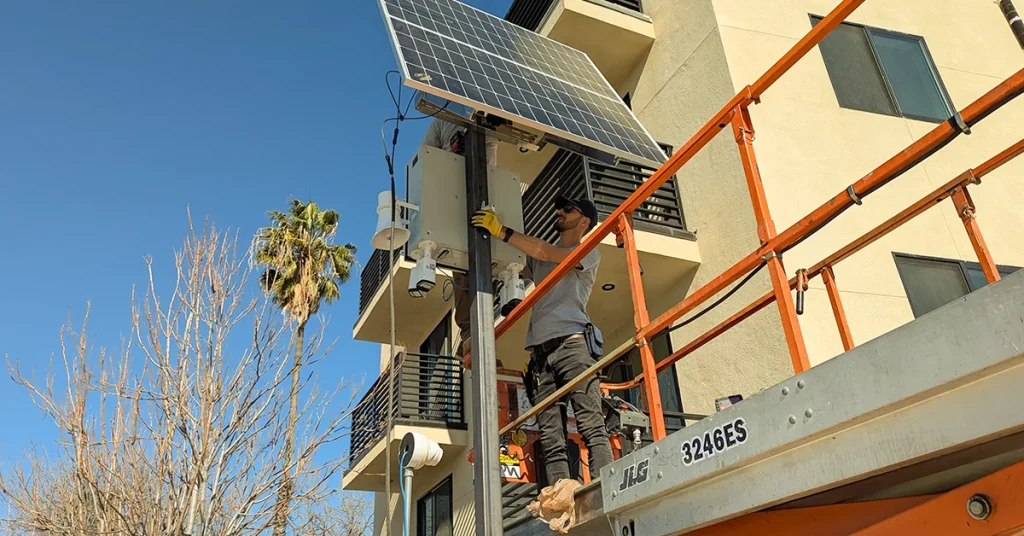
Solar Security Cameras for Construction Sites in Los Angeles
Your site isn't in the middle of nowhere. It's in Culver City, or Burbank, or somewhere in the Valley. There's a utility pole on the street. Power is coming. It's just not here yet, and the build is in month two.
So the site sits unmonitored through the phase when copper, tools, and materials are most exposed.
This is one of the most common security gaps on active construction sites across Greater Los Angeles. It has nothing to do with remoteness.
It's a timing problem: real electrical infrastructure is weeks or months away, and everything that could carry a camera in the meantime is either already maxed out or not worth the permit timeline.
Solar-powered security cameras on construction sites in the Greater Los Angeles area eliminate the need for temporary power hookups, reducing both cost and setup time for site superintendents managing active builds.
Our internal ValleyGuard incident data show that 29% of monitored incidents at construction and commercial sites occur between 10 pm and 6 am, with peak activity on Fridays, Saturdays, and Sundays.
That's the window when an active urban job site is empty, the temp power is off, and nothing is watching the materials staged for Monday's crew.
Jump to: The power problem | What changes on site | ValleyGuard monitoring | Fitting your plan
The Power Problem on an Active Urban Build
A construction site in the city of Los Angeles has nearby electrical infrastructure. That's not the issue.
The issue is that the permanent utility service for the building under construction isn't established until the build is well along, and the temporary power on-site is fully committed to the work.
Temp panels run the saws, compressors, the lifts, and the site lighting. Adding a hardwired camera system means competing for circuits that are already allocated.
More practically, it means running camera-specific conduit through a site that's changing every week, coordinating with a licensed electrician against a permit timeline that LA doesn't make fast, and wiring cameras to positions that may not make sense in two months when the structure has changed.
The result is that most job sites in Los Angeles don't get a real camera system until the build is far enough along for permanent power to be realistic.
Everything before that is either a consumer camera plugged into temp power or nothing at all.
Why Temp Power Isn't a Real Solution
Plugging cameras into a temporary construction circuit creates a different problem. Temp power goes off when the crew leaves. It trips on GFCI breakers.
It gets unplugged by whoever is last to be near the panel. A camera that runs on temp power is operational during working hours and is off every night and weekend. Precisely when the site is most vulnerable.
Motion-triggered phone alerts look like a workaround. In practice, a GC gets a notification at 2 am, checks the thumbnail, can't tell if it's wind or a person, and by the time they confirm it's real, whoever was on the site is already gone. That's not monitoring. That's delayed documentation.
What Solar Pole Cameras Change on a Job Site
A solar pole-mounted camera unit doesn't touch the site's electrical system at all. It runs off its own panel and battery, transmits over its own cellular LTE connection, and mounts to any structure from which a camera can be pointed: a wall, a framing member, a fence post, or a site perimeter structure.
It's live 24 hours a day, regardless of what the temp panel is doing.
Construction sites across the San Fernando Valley and Inland Empire frequently lack active utility service during early build phases. Solar pole cameras with cellular uplink provide immediate monitored coverage without waiting for electrical infrastructure.
Valley Alarm conducts a site walk, identifies the coverage positions that align with the current build phase, mounts the units, and connects them to ValleyGuard monitoring within 48 hours.
No electrician. No permit for a camera circuit. No conduit run through active construction.
And because the units aren't anchored to an infrastructure run, positions can shift as the build progresses and the high-risk areas change.
When permanent utility service does come online later in the build, the solar pole cameras don't have to be removed.
They keep running exactly as before. And the positions they're covering- the perimeter corners, the far gate, the staging area that's 150 feet from the panel- still can't be reached cost-effectively by a hardwired run.
For a full overview of how solar pole cameras work across all commercial property types, see the complete guide: Commercial Security Without Wiring.
If your site is remote rather than urban, think hillside grading, early-phase land development in the Antelope Valley or Ventura County, or a site where even cell service is limited, the coverage considerations are different.
See remote construction site protection for LA jobsites for that specific scenario.
ValleyGuard Monitoring on Active Los Angeles Construction Sites
Getting cameras live is the first problem. What happens when they detect something is the second.
Valley Alarm's solar-powered jobsite cameras connect to ValleyGuard, the live remote video monitoring service staffed 24/7 by US-based Intervention Specialists.
When a camera flags activity during a monitored window, a Specialist pulls the live feed and assesses it in real time.
If the activity is unauthorized, an audio warning goes through the on-site speaker immediately. Most incidents end there.
At a construction site in Culver City, a ValleyGuard Intervention Specialist detected an intruder dressed in black entering the property at 4:46 am on a Thursday.
A stern audio warning was issued immediately. Law enforcement was contacted, and a patrol was dispatched. The intruder was identified from the live feed before officers arrived.
At a manufacturing facility in Rancho Cucamonga on a long-term ValleyGuard deployment, Intervention Specialists logged more than 150 incidents over the monitoring period.
In one incident in November 2025, an individual was observed stealing pallets from the site. Multiple audio warnings were issued. When the individual didn't comply, the San Bernardino Sheriff was dispatched.
That site has seen 26 law-enforcement dispatches throughout the deployment. The cameras ran on solar throughout, with no grid dependency and no gaps when site power cycled.
See more documented interventions at active Los Angeles sites at ValleyGuard catches on camera.
How Solar Pole Cameras Fit Your Construction Security Plan
Solar pole cameras solve one specific piece of the construction site security problem: providing live, monitored coverage of a site during the build phase, before electrical infrastructure is available to support a hardwired system.
They don't replace a full security strategy. They fill the gap that leaves sites unmonitored precisely when materials and equipment are most exposed.
For the broader picture on protecting an active Los Angeles job site, the construction site security guide covers the full strategy across all build phases.
For why passive cameras keep failing even when they're installed, see how ValleyGuard stops construction theft in real time.
And for the overnight and weekend timing patterns that make after-hours coverage different from daytime, see construction site overnight theft prevention in LA.
Solar pole cameras are where that coverage starts. From day one of the build, not from the day the electrician finally shows up.
Frequently Asked Questions
Can solar cameras handle the conditions on an active construction site?
Yes. Commercial solar pole-mounted camera units are built for outdoor industrial environments. They're weatherproofed, designed to operate in dusty, exposed conditions, and run on a battery system with enough reserve to stay live through multiple overcast days.
The cellular LTE uplink doesn't depend on any on-site network, so connectivity isn't affected by whatever's happening with the site's temp power or wifi.
A site super doesn't have to carve out a circuit, coordinate an electrician, or wait for a permit to get cameras running.
How quickly can solar cameras be deployed at a Los Angeles construction site?
Valley Alarm can complete a site walk and have solar pole-mounted cameras operational within 48 hours.
There's no permit required, no electrical contractor to coordinate, and no conduit work. For sites that need coverage immediately, that's usually the fastest path from nothing to live monitored coverage.
When do most construction-site thefts occur in Los Angeles?
ValleyGuard incident data shows 29% of monitored incidents at construction and commercial sites occur between 10 pm and 6 am. Peak activity falls on Fridays, Saturdays, and Sundays, when sites are empty for the longest stretches.
That's the window solar pole cameras are specifically designed to cover: overnight and weekend hours when no one's on-site and temp power is off.
What's the difference between a solar pole camera and a mobile surveillance trailer on a construction site?
A solar surveillance trailer is a large, wheeled unit that repositions across the site as the build progresses. It's a strong option for sites that need a highly visible deterrent or broad coverage from a single position.
A solar pole-mounted camera is a fixed unit that mounts to an existing structure and covers a specific perimeter point or entry.
On many job sites, both are deployed together: trailers for broad coverage and pole cameras for specific entry points or blind spots that the trailer can't reach. Both connect to ValleyGuard live monitoring.
Can camera positions be moved as the site changes?
Yes. Because solar pole cameras aren't anchored to a conduit run or hardwired circuit, they can be repositioned when the build progresses and coverage needs shift. Valley Alarm handles the repositioning as part of the ongoing deployment.
A camera that covered the material staging area in month two can move to cover the mechanical room access in month five without any electrical work.
Do solar cameras still make sense once permanent power is available later in the build?
Yes. Once permanent utility service comes online, the solar pole cameras don't need to be swapped out. They keep running on their own panel and battery exactly as before.
At that point, you can leave the solar units in place, add hardwired cameras where the new infrastructure supports it, or both. The solar units don't become redundant just because power arrives.
They still cover the perimeter positions that hardwired cameras can't reach cost-effectively.
Coverage shouldn't wait for the electrician.
Valley Alarm can walk your site and have solar pole-mounted cameras connected to live ValleyGuard monitoring within 48 hours. No temp power needed. No permit. No conduit.
The gap before power arrives doesn't have to go unwatched.
Valley Alarm can walk your site and have solar pole-mounted cameras connected to live ValleyGuard monitoring within 48 hours. No conduit, no permit, no electrician.
Related Articles
- →Construction Site Security Guide for Los Angeles Contractors
- →How ValleyGuard Stops Construction Theft
- →Construction Site Overnight Theft Prevention in Los Angeles
- →Remote Construction Site Protection for LA Jobsites
- →Commercial Security Without Wiring: The Complete Guide
- →ValleyGuard Catches on Camera
- →Valley Alarm Solar Pole-Mounted Camera Service
- →Valley Alarm Mobile Surveillance Trailers
- →Solar Security Cameras for Car Dealerships in Los Angeles
- →Solar Security Cameras for Vacant Properties in Los Angeles

- Remote Video Monitoring: The Complete Guide for Commercial Properties - August 13, 2026
- How Much Does Remote Video Monitoring Cost? - August 13, 2026
- Remote Video Monitoring for Apartment Complexes and Multi-Family Properties - August 13, 2026