
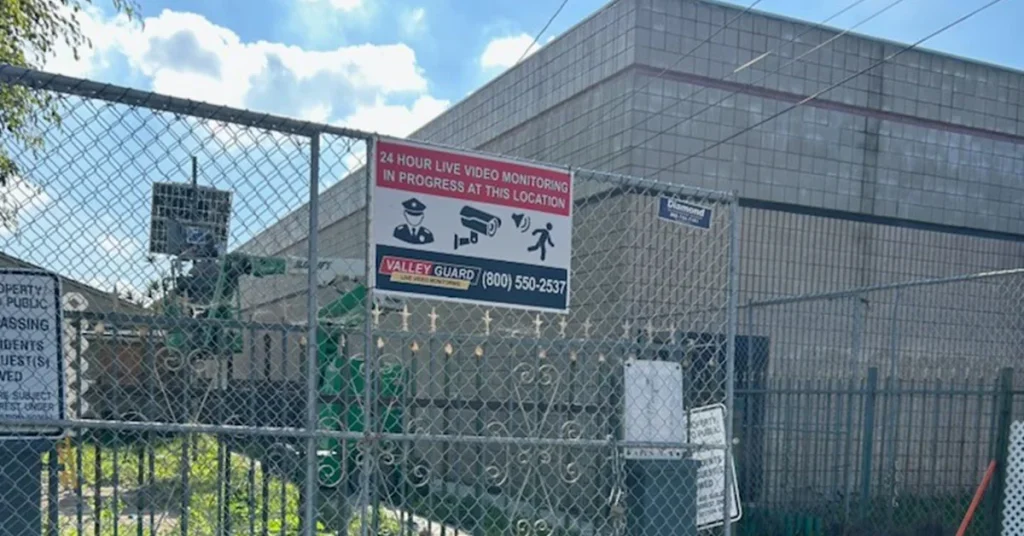
Solar Security Cameras for Vacant Properties in Los Angeles
Vacant properties don't have a power panel with an open breaker. They don't have a network closet. In many cases, they don't have a building at all.
The utility account has been canceled, the meter has been pulled, and the lot is sitting there with nothing but a fence and whatever lighting was already on the poles.
That's what makes vacant property security fundamentally different from every other security problem. It's not that the cameras are hard to position. It's that there's nothing to plug them into and nothing to connect them to.
Vacant commercial properties in Greater Los Angeles are frequent targets for theft, vandalism, and trespassing. Solar pole cameras provide monitored surveillance on parcels with no active utility service.
Solar pole-mounted cameras are the only commercial surveillance option that doesn't require you to solve the power and network problem first.
The unit is entirely self-contained. It generates its own power, stores it in an onboard battery bank, and transmits over cellular LTE.
There's nothing to plug in and no network to join. That makes it the right fit for every type of vacant commercial property that's sitting without active infrastructure.
Jump to: What targets vacant sites | Why wired cameras fail | What ValleyGuard logs | When it changes hands
What's Targeting Vacant Properties in LA
Unmonitored vacant lots and buildings in the Greater Los Angeles area get hit in predictable patterns. Trespassing is the most consistent issue.
A vacant property is quickly identified: no lights on inside, no vehicles, no activity. It becomes a reliable point of entry for people who know it won't be watched.
The first trespass is usually reconnaissance. The second is usually more organized.
Copper theft is a recurring secondary problem on properties where HVAC units, electrical conduit, or plumbing are still accessible.
Thieves strip copper from vacant buildings efficiently because there's no one on site to detect them and no live monitoring to interrupt the work.
By the time the owner or manager does a physical inspection, the copper is already gone.
Illegal dumping, vandalism, and vehicle break-ins are lower on the organization scale but happen constantly on unmonitored vacant lots. A
nd on properties where squatters have established a presence, fire risk becomes a real liability concern.
Illegal cooking setups and improvised electrical connections are direct causes of vacant building fires in Los Angeles.
The common factor across all of these is that they happen on properties nobody is watching. A camera that records but doesn't have live monitoring doesn't change the equation.
The activity still happens. The footage gets reviewed after the fact. Nobody gets stopped.
Why Conventional Cameras Can't Cover a Vacant Lot
The standard approach to commercial surveillance requires two things that vacant properties don't have: power and a network connection.
A hardwired camera system needs both to operate. Running conduit across a vacant lot to power camera positions requires pulling a permit, hiring an electrician, and trenching through pavement or dirt.
That's a substantial cost and lead time on a property that may be transitional, held for development, or between tenants for an undefined period.
Consumer-grade solar cameras seem like a solution, but they're not. Products like Reolink, Arlo, and similar brands are designed for residential use on properties with active WiFi. They depend on a home network to function. Without it, they go offline.
On a vacant commercial property with no active internet service, they don't connect to anything. And on the ones that do support cellular data, the monitoring model is passive.
The camera records to a cloud account, and someone reviews the footage after the fact. There's no live intervention.
No Power. No Network. No Structure.
Vacant commercial land presents the maximum version of the infrastructure problem. There's no building to mount to, no electrical service to tap, and no network to connect to.
A standard mounting location doesn't exist. A solar pole-mounted unit resolves all three gaps at once. It mounts to any existing pole on or near the property, whether that's a lighting standard, a utility pole, a fence post, or a standalone pole driven specifically for camera placement.
The unit generates and stores its own power. The ValleyGuard connection runs over cellular LTE.
The result is a camera position at any point on the property that doesn't depend on any existing infrastructure.
For vacant lots that have been sitting without power for months or years, that's the only viable path to live monitored coverage.
For the full picture of how this applies across commercial property types, see the complete guide: Commercial Security Without Wiring.
What ValleyGuard Monitoring Logs on Vacant Sites
Valley Alarm's pole-mounted solar cameras connect to ValleyGuard, the live 24/7 monitoring service staffed by US-based Intervention Specialists.
When a camera detects activity on a monitored vacant property, a Specialist reviews the live feed in real time. If the activity is a confirmed intrusion or threat, they immediately issue an audio warning through the on-site speaker.
If the intruder doesn't respond, law enforcement is contacted with a real-time description and video verification.
Property management companies overseeing vacant or transitional commercial sites across Los Angeles, the Inland Empire, and Ventura County use solar-powered surveillance cameras because they require no electrical infrastructure and can be redeployed as the property changes hands.
A commercial property in Pomona that had been experiencing trespassing and vandalism incidents prior to monitoring has logged more than 30 ValleyGuard incidents since the cameras went live.
The monitoring pattern at that site reflects what Valley Alarm consistently sees on vacant and transitional commercial properties: activity concentrates in the late-night window, and the same areas of the property are targeted repeatedly once a gap in coverage is identified.
Valley Alarm also monitors a storage property in Inglewood under the same model. No internet, no active utilities on site, cameras running on solar and transmitting over cellular. ValleyGuard covers it the same way it covers any monitored commercial site.
See documented ValleyGuard interventions across monitored commercial sites at ValleyGuard catches on camera.
For more on how live video monitoring benefits vacant and transitional commercial properties in the Greater Los Angeles area, see Valley Alarm's vacant property monitoring service.
When the Property Changes Hands
A solar pole-mounted camera isn't a permanent installation in the same way a hardwired system is. It mounts to an existing pole without drilling into the building structure or pulling conduit through the property.
When the property sells, is leased to a new tenant, or enters a renovation phase, the cameras come down and are redeployed elsewhere.
That redeployment flexibility matters for property managers holding multiple vacant parcels in a portfolio. The cameras don't stay tied to a specific address. They move as the coverage need moves.
A property that's been vacant for a year and just signed a letter of intent needs monitoring through escrow and transition.
Once it's occupied and the new tenant has their own security infrastructure, the cameras redeploy to the next vacant parcel in the portfolio.
For properties transitioning from vacant to active construction, the same cameras that covered the empty lot stay in position through the build phase.
The threat profile shifts from trespassers and copper thieves to tool and materials theft, but the monitoring setup doesn't change. Valley Alarm covers both phases under the same ValleyGuard monitoring account.
For vacant properties where temporary staging or rapid repositioning takes priority over fixed perimeter coverage, Valley Alarm's mobile surveillance trailers(opens in new tab) may be a better fit.
A trailer deploys in 24 to 48 hours and relocates as needed. A solar pole camera is the right choice for a fixed perimeter position that requires consistent coverage while the property remains vacant.
The determining factor is whether the lot needs a fixed point or a mobile presence.
Frequently Asked Questions
Can solar cameras work on a property with no power at all?
Yes. Solar pole-mounted cameras are fully self-contained. The unit generates power from the solar panel, stores it in an onboard battery bank, and transmits footage over cellular LTE.
There's no connection to the property's electrical service and no WiFi required.
A vacant lot that hasn't had active utilities in years is a viable deployment location as long as there's a mounting surface and adequate sun exposure.
What types of vacant properties does this work for?
Any commercial property without active electrical service. That includes vacant commercial land awaiting development, bank-owned commercial properties, buildings between tenants, surplus lots held by property management companies, and transitional parcels in escrow or pre-renovation.
The only requirement is a mounting surface: an existing light pole, utility pole, fence post, or a standalone pole installed specifically for camera placement.
How does ValleyGuard respond when someone enters a vacant property?
When a ValleyGuard-connected solar camera detects motion during a monitored window, the event is routed to a live Intervention Specialist, who reviews the feed in real time.
If the activity is confirmed as trespassing or a threat, the Specialist issues a live audio warning through the on-site speaker. Most intruders leave when they hear a live voice.
If the subject doesn't respond to the warning, law enforcement is contacted immediately with a real-time description of the individual and any vehicles present.
What happens to the cameras when the property sells or gets a new tenant?
Solar pole-mounted cameras aren't permanently attached to the property. They mount on poles without structural modifications to the building, and they come down cleanly when the need for coverage ends.
Valley Alarm removes and redeploys the equipment to a new location.
For property management companies with rotating vacancy across a portfolio, that means the same monitoring investment covers multiple properties over time as occupancy status changes.
What's the difference between a solar pole camera and a mobile surveillance trailer for a vacant lot?
A solar pole-mounted camera is a fixed unit that remains permanently at a specific position. It's the right fit for a vacant lot where the same perimeter points need consistent, long-term coverage.
A mobile surveillance trailer is a larger unit on wheels that deploys rapidly and can be repositioned as needed. It's a better fit for situations where coverage needs to move frequently or where a highly visible deterrent tower is the goal.
Both connect to ValleyGuard live monitoring and deploy within 48 hours of a site walk.
How quickly can cameras be deployed on a vacant property with no infrastructure?
Valley Alarm can complete a site walk and have solar pole-mounted cameras connected to live ValleyGuard monitoring within 48 hours.
There's no permit to pull, no electrician to schedule, and no conduit or trenching work required.
For properties that've just had a trespassing incident or a theft, that deployment timeline means the next overnight window can be covered.
The vacant lot doesn't have to stay unmonitored.
Valley Alarm can walk your property and have solar pole-mounted cameras connected to live ValleyGuard monitoring within 48 hours. No conduit, no permit, no electrician. Even if the utilities have been off for years.
Related Articles
- →Commercial Security Without Wiring: The Complete Guide
- →Valley Alarm Solar Pole-Mounted Camera Service
- →Vacant Property Remote Video Monitoring
- →Solar Security Cameras for Parking Lots in Los Angeles
- →Solar Security Cameras for Logistics Yards
- →ValleyGuard Catches on Camera
- →Valley Alarm Mobile Surveillance Trailers

- Remote Video Monitoring: The Complete Guide for Commercial Properties - August 13, 2026
- How Much Does Remote Video Monitoring Cost? - August 13, 2026
- Remote Video Monitoring for Apartment Complexes and Multi-Family Properties - August 13, 2026