
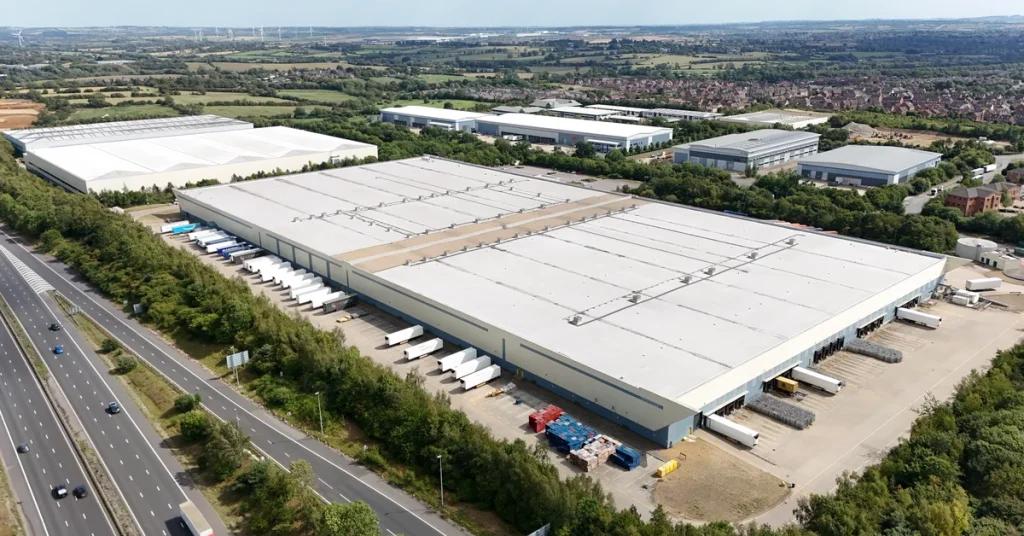
The Fence Line Is Half a Mile Long. Your Cameras Cover the Front Gate.
Industrial sites get secured from the inside out. The office gets an alarm, the shop gets cameras, and the yard, which is where the material actually sits, gets a chain-link fence and a light on a pole.
Then something goes missing from the far corner, and the footage shows a truck-shaped blur at the edge of the frame.
Industrial live video monitoring covers perimeter fence lines, gate entries, equipment and material storage areas, and trailer or vehicle staging, with AI detection tuned to shift schedules so normal operations don't generate alerts. Valley Alarm monitors industrial sites across Los Angeles County and the Inland Empire from a UL-listed center staffed by US-based Intervention Specialists.
Jump to: Perimeter, not the building | What gets stolen | The shift-change gap | Sites with no power | Why more cameras fail | Cost vs a gate guard
Industrial Live Video Monitoring Starts at the Perimeter, Not the Building
A distribution warehouse and a metals yard have different problems, even when they sit on the same street.
The warehouse risk is concentrated at dock doors and inside the building, which is covered in the warehouse security guide. If you want the service itself explained first, start with the remote video monitoring guide. The industrial risk is spread across an outdoor footprint: fence lines, laydown yards, fuel and equipment storage, and whatever is staged outside because it doesn't fit indoors.
That footprint has three properties that make it hard to secure. It's large, so a patrol takes time to cross. It's poorly lit, because lighting an acre costs real money. And it usually has more than one way in, including the gate somebody props for deliveries and the fence section that's been cut and wired back twice.
What Actually Leaves an Industrial Site
Not the equipment you'd expect. The things that move are the things that can be resold without paperwork.
Copper and wire. Spooled, scrapped, or pulled out of something that was working an hour ago.
Raw material and metal stock. Anything that a scrap yard buys by weight.
Catalytic converters and parts. From fleet vehicles parked in the yard overnight.
Fuel. Out of tanks and out of equipment, which rarely gets noticed until a machine won't start.
Batteries and small equipment. Portable, valuable, and easy to carry over a fence.
It's usually gone before anyone knows it's happening, which is why recorded footage ends up being a claims exercise rather than a security measure.
The Shift-Change Gap
Sites that run multiple shifts have a repeating window where nobody is really watching.
The outgoing crew is putting tools away and heading for the gate. The incoming crew is arriving in ones and twos. The yard is busy, unfamiliar vehicles are normal for twenty minutes, and anyone walking through with purpose reads as an employee.
AI rules don't care that the shift is changing. Zones stay armed while gates are open. Vehicle access rules apply to the yard even when the front is busy. An Intervention Specialist sees the same yard at 6 AM as at 2 AM.
That's also why the overnight-only assumption fails here. 43% of ValleyGuard's logged incidents happen during normal business hours.
Coverage Where There's No Power
The far fence line is the part of the property most likely to be hit and least likely to have conduit run to it.
Solar-powered pole-mounted cameras solve that. They don't need trenching, they don't need an electrical permit, and you're not waiting for a contractor to run power out to a corner nobody visits. For sites that need coverage to move as the operation moves, a solar-powered mobile security trailer does the same job on wheels.
Both connect to the same live monitoring, and neither one is standalone recording equipment. The deployment options are covered in commercial security without wiring.
Why More Cameras Don't Fix This
Plenty of industrial sites already have more cameras than anyone can watch. The problem isn't camera count; it's that nobody's watching them, and the alerts stopped meaning anything a while ago.
A camera pointed at a yard where trucks move all day constantly generates motion events. Left untuned, the alerts become noise, and the noise gets muted. By the second week of properly tuned rules, false alarms drop 80 to 90%, which is the difference between a system people respond to and a system people silence.
The other half is verification. When a real detection comes in, a Specialist reviews it live and makes a decision. At a Gardena storage and logistics facility on September 3, 2025, a detection at 1:46 AM prompted the Specialist to contact the LA County Sheriff's Department at 1:56. A patrol was dispatched, and there was no damage or theft.
More of those are documented on the ValleyGuard live monitoring catches page.
What Monitoring Costs Against a Guard at the Gate
The usual alternative is a guard in a booth, and the honest read is that a booth guard secures the gate and nothing else.
Industry-wide, a single guard shift runs $3,000 to $5,000 per month, and round-the-clock coverage for one property typically exceeds $10,000 per month. Those are industry figures, not Valley Alarm's. On a site with a long perimeter, that money buys presence at one point while the fence line stays dark.
Monitoring is quoted per site based on camera count, coverage hours, and deployment method. What drives that number is broken down in how much does remote video monitoring cost.
Frequently Asked Questions
What's the difference between industrial and warehouse video monitoring?
Warehouse coverage focuses on dock doors, receiving areas, and interior zones where cargo and internal theft pose risks. Industrial coverage is about the outdoor footprint: perimeter fence lines, laydown yards, fuel and material storage, and vehicle staging. Plenty of facilities need both, and that's what the site walk sorts out.
Can cameras cover a fence line with no power nearby?
Yes. Solar-powered, pole-mounted cameras run on battery and solar power, with cellular connectivity, so a fence corner without conduit can still be covered without trenching. Solar-powered mobile security trailers do the same job when coverage needs to be relocated.
How do you keep normal yard traffic from triggering constant alerts?
Zones, schedules, and vehicle rules get tuned to how the site actually runs, including shift changes and delivery windows. Once they're tuned, false alarms drop by 80 to 90% by the second week, and the alerts that remain are worth looking at.
Do the Intervention Specialists contact police directly?
Yes, and the call goes in with eyes on the person and a description of what's happening, which isn't the same as an unverified alarm signal. Every incident is documented with timestamped video.
Does this replace our on-site guard?
Sometimes it replaces one, and more often it changes what the guard is there for. Monitoring covers the perimeter and the hours when the site's empty, and a guard handles access control and people during working hours. The comparison is worked through in how remote monitoring replaces security guards.
Cover the fence line, not just the front gate.
Valley Alarm monitors industrial facilities and logistics yards across Los Angeles County and the Inland Empire, including sites with no power at the perimeter. Talk through coverage for your yard.
Related Articles
- →Remote Video Monitoring: The Complete Guide
- →Warehouse Security Guide for Southern California
- →Industrial Security Camera Systems for Los Angeles Facilities
- →Commercial Security Without Wiring
- →How Much Does Remote Video Monitoring Cost?
- →Live Video Monitoring Catches on Camera
- →Live Video Monitoring for Los Angeles Industrial Sites

- Remote Video Monitoring: The Complete Guide for Commercial Properties - August 13, 2026
- How Much Does Remote Video Monitoring Cost? - August 13, 2026
- Remote Video Monitoring for Apartment Complexes and Multi-Family Properties - August 13, 2026