Why LA Contractors Are Replacing Security Guards With Remote Video Monitoring
It's 2:14 AM at your San Fernando Valley jobsite. Your guard is in the site office on a bathroom break. Three men cut through the south fence in under 90 seconds, load $15,000 in copper wire onto a pickup, and are gone by 2:21 AM. Y
our guard discovers the fence cut at shift change. By then, the copper's already at a scrap yard.
Security guards covering overnight construction sites in Los Angeles cost $50 to $60 per hour at base rates, with a 12-hour overnight shift running $600 to $720 per night. For a three-site contractor, monthly guard coverage approaches $54,000 to $84,000 before overhead. Remote video monitoring covers multiple construction sites simultaneously from a single center at a fraction of the cost, with faster response times and no coverage gaps due to shift changes, fatigue, or patrol blind spots.
That's not a failure of your guard's effort. It's a failure of the model. One person can't watch 4 acres of perimeter simultaneously, and no amount of diligence closes that gap.
Most contractors don't consider remote video monitoring until after guards have failed. That's usually when the math becomes undeniable.
This article breaks down what remote video monitoring actually costs compared to security guards, why the guard model has structural limitations no individual guard can overcome, and how contractors across Los Angeles are getting better coverage for less money.
Jump to: What monitoring is | Monitoring vs cameras | The cost of guards | Guard coverage gaps | What happens on detection | AI detection over time | LA targeting patterns | Case study | What to look for | When to replace guards
What Remote Video Monitoring Actually Is
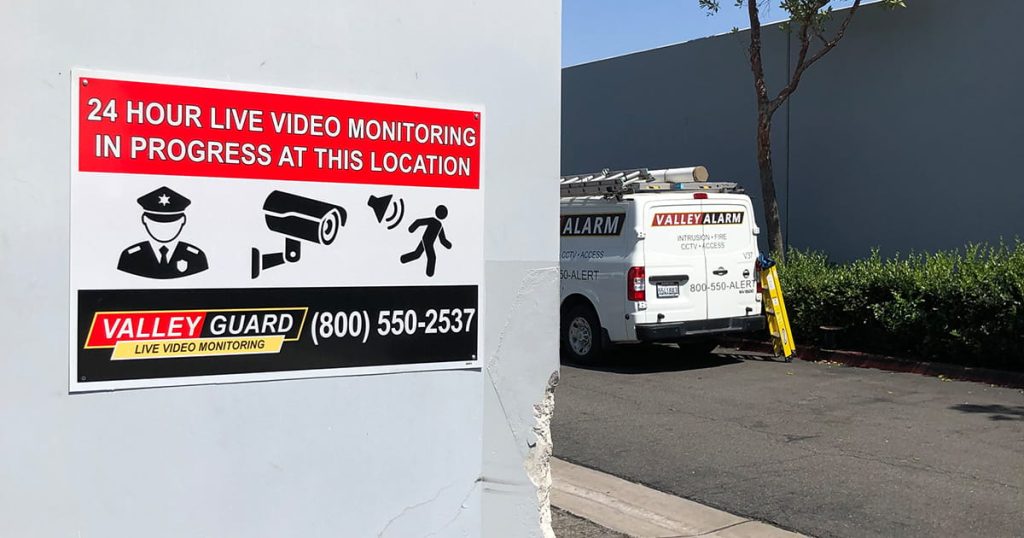
Remote video monitoring isn't cameras that record footage for later review. It's live operators watching AI-powered cameras in real time, responding to threats as they happen, and stopping crime before theft occurs.
When someone enters a monitored construction site after hours, here's what happens. AI-powered cameras detect the motion and send an alert to a U.S.-based monitoring center within seconds.
A live operator reviews the feed, confirms the threat is real, and issues a voice warning through on-site speakers:
"This is Valley Alarm security. You are being recorded. Leave the property immediately."
If the intruder doesn't leave, the operator calls 911 with video verification of an active intrusion.
The difference between this and a security guard isn't effort or training. It's coverage. One guard can patrol 2 to 3 acres at a time.
A monitoring center watches every camera on your entire site simultaneously, regardless of acreage. Coverage is one of several decisions on an LA jobsite.
The construction site security guide for Los Angeles contractors compares deployment options, overnight risk, and insurance requirements.
Remote Video Monitoring vs. Traditional Cameras
Standard CCTV gives you footage for review after something's gone wrong. Motion alerts go to your phone, you check the clip, and if it's real, you call the police. By then the theft is done.
That's a reactive system built on the assumption that someone's awake and watching their phone at 2 AM.
Remote monitoring is different in kind, not just degree. Trained operators monitor live feeds around the clock, so a response occurs while the intruder is still on your property.
AI filters out false triggers: tarps, headlights, animals. Operators aren't drowning in noise when a real event happens. When police are dispatched, it's with video verification of a confirmed crime in progress, not a motion sensor that tripped on a passing truck.
Video-verified calls receive higher priority from dispatch than standard alarm signals, and police treat them as crimes in progress rather than routine responses.
The Real Cost of Security Guards
Most contractors underestimate what they're actually spending on guard coverage. The base rate for construction security guards in Los Angeles runs $50 to $60 per hour.
For a 12-hour overnight shift, that's $600 to $720 per night, or $18,000 to $21,600 per month at base.
Factor in overtime, holidays, and workers' compensation insurance, typically another 20 to 30%, and the real monthly cost for one guard runs $21,600 to $28,000.
For contractors running multiple sites, the costs compound fast. Three sites with overnight guard coverage run $64,800 to $84,000 per month.
That's before management overhead, shift replacements for sick days, and the coordination cost of keeping coverage consistent across locations.
Those figures assume the guard model is working as intended. In practice, it has structural limits that don't show up in any line item.
Why Guards Can't Cover Everything
A guard working a 5-acre site isn't underperforming if a theft crew gets through while he's at the north gate. That's the geometry of the job. One person can effectively patrol 2 to 3 acres at a time.
Large equipment blocks sightlines. Material piles create blind spots. Organized theft rings study patrol patterns and time their entry around the gaps: shift changes, bathroom breaks, the predictable route a guard walks when it's 3 AM and nothing has happened for four hours.
Night shift fatigue compounds this. Alertness naturally drops after midnight on a long, uneventful shift.
That's not a character issue; it's physiology. Mobile phone distraction during quiet hours is a real factor that no supervision model fully eliminates.
The Inside Job Risk
This is the conversation contractors don't like having, but it's a documented problem. Guards can be bribed or coerced by organized theft rings that study their routines.
Some will share schedules, camera blind spots, or delivery information with outside crews. When it does happen, the contractor's got no visibility into it until the damage is done.
Remote monitoring eliminates this risk category entirely. Operators aren't physically on-site. They don't have access to keys, materials, or equipment.
Multiple operators rotate shifts with full activity logging, so there's no single point of failure.
The monitoring center only knows what the cameras show – not when copper is delivered, not where the highest-value materials are staged.
The Scalability Problem
Guard costs don't scale. If one guard covers 2 to 3 acres, adding acreage means adding guards.
A second site means a second team, the same management overhead, and the same variable costs for sick days and overtime. There's no efficiency gain as the operation grows.
Remote monitoring doesn't work that way. One monitoring center covers multiple sites without adding operators.
Camera infrastructure scales across locations without adding headcount. The marginal cost of a second or third site is significantly lower than the first.
What Happens When Monitoring Detects an Intrusion
This is a real timeline from a Los Angeles jobsite:
- 11:43 PM: AI camera detects motion near the south gate.
- 11:43 PM: Alert reaches the monitoring center within 3 seconds.
- 11:43 PM: Operator reviews the live feed and confirms a human intruder.
- 11:44 PM: Operator activates on-site speaker: "This is Valley Alarm security. You are being recorded. Leave the property immediately."
- 11:44 PM: Intruder looks directly at the camera and moves toward the exit.
- 11:45 PM: Operator monitors until the intruder has fully left the property.
- 11:47 PM: Incident report sent to the contractor with a timestamped video clip.
Total time from detection to resolution: 4 minutes. Zero theft.
A guard patrolling the same site might not discover the cut fence for 20 to 30 minutes, by which time the copper has already been loaded and gone. That gap is the difference between evidence and prevention.
If the intruder doesn't respond to the audio warning, the operator calls 911 with video verification of an active intrusion.
The operator stays on the line, providing real-time updates on location and movement. Police treat these calls as crimes in progress, not routine alarm responses.
How AI Detection Gets Smarter Over Time
The AI running camera detection learns your site's normal patterns during the first week of operation. It builds a baseline: delivery trucks, worker arrivals, authorized vehicles, routine perimeter movement.
By week two, false alarms have dropped 80 to 90% because the system filters out tarps moving in the wind, animals crossing the frame, and car headlights from the street.
By month two, the system recognizes behavioral anomalies that a guard wouldn't catch: someone lingering near copper storage longer than normal, an unknown vehicle entering outside scheduled hours, or movement approaching from an unusual direction.
These get flagged for operator review before they become a perimeter breach.
AI doesn't get tired. It doesn't have a 3 AM energy dip or a predictable patrol route that a theft crew can map. It processes every camera feed simultaneously, something a human guard physically can't do.
Los Angeles Construction Sites Are Targeted Differently
Copper prices have remained at historic highs, making wire theft more profitable than it has been in years. Los Angeles has one of the highest construction site theft rates in California, and project timelines of 12 to 24 months create extended periods of vulnerability.
Multi-site contractors can't staff guards across every location without absorbing costs that erode project margins.
The neighborhoods with the highest repeat targeting – San Fernando Valley, North Hollywood, East Hollywood, Van Nuys, Burbank industrial corridors – see organized crews who study sites over days or weeks before hitting them.
They know what passive camera systems look like. They know patrol patterns. They know when the guard is on break.
Case Study: Robert Marshall, Los Angeles Roofing Company
Robert Marshall, Safety Director at a Los Angeles-area roofing company, was managing security across multiple material yards and active job sites. Repeated break-ins targeted copper and brass fixtures and tools. Hiring guards across all locations would have cost $18,000 to $22,000 per month. For 3 locations, that's $54,000 to $66,000 per month before management overhead and sick-day coverage gaps.
The company switched to Valley Alarm's remote video monitoring with AI detection and live audio warnings across their yards and job sites.
Here's what Marshall said after the switch:
“Before we installed AI-powered security, we were dealing with constant break-ins, false alarms, and stolen materials. It was frustrating and costly. Since installing remote surveillance, thefts have dropped. Now, intruders are stopped before they can even cause damage.” – Robert Marshall, Safety Director
After switching, break-ins dropped from a constant cycle to near zero. Live operators confronted trespassers before damage occurred. AI detection eliminated the false alarm volume that had been burning out the team. Every event generated a timestamped incident report that the company could use for documentation.
Watch Robert Marshall's full testimonial, or see how ValleyGuard combines AI with live operators to stop theft before it happens.
What to Look for in a Remote Monitoring System
Not every monitoring provider is built for construction. The cameras need to work in conditions that standard commercial hardware can't withstand: dust, rain, vibration from heavy equipment, temperature swings, and sites without permanent power or internet access.
Night color cameras matter more than most contractors realize. Standard IR cameras give you grayscale footage.
You can see movement, but you can't see that the person at the gate is wearing a red jacket or driving a white pickup. Night color cameras give operators the detail they need to provide meaningful descriptions to police dispatch.
Two-way audio isn't optional. Without it, the monitoring center can watch but can't intervene. The live audio warning is what stops 98% of intrusions before they become theft. A system without it is expensive CCTV.
AI detection that learns your specific site is what prevents alert fatigue. Generic motion detection on a construction site fires constantly from cranes, tarps, and headlights passing on the street.
A system that learns your site's baseline is the difference between an operator who's sharp at 3 AM and one who's been conditioned to ignore alerts.
For sites without power or permanent structures, solar-powered mobile trailers and pole-mounted cameras are the practical option. They deploy within 24 to 72 hours and relocate as the project progresses, so coverage moves with the site.
Before committing to a provider, get answers to three questions: Where is your monitoring center located, and are operators US-based? What's your average time from alert to operator response? And what does incident reporting look like – do you get timestamped footage, or just a notification?
When It Makes Sense to Replace Guards
The guard model works in specific scenarios. If you need physical crowd control during business hours, signature verification for material receiving, or uniformed presence required by city code or contract, guards serve a function that cameras and audio can't replace.
Some contractors run a hybrid: guards during the day, remote monitoring overnight. That cuts guard costs by 50-70% while maintaining a physical presence when workers and deliveries are on-site.
Where the guard model breaks down is after-hours coverage on sites over 2 to 3 acres, multi-site operations where scaling guard teams becomes cost-prohibitive, and situations where you've already had incidents despite having guards in place.
If you're spending $15,000 or more per month on guard coverage and still getting hit, or managing more than one site and doing the math on what guard teams cost at each location, that's when remote monitoring changes the calculation.
Replace overnight guard coverage without losing protection.
Get the coverage of a full team without paying for overnight shifts. ValleyGuard detects real threats, verifies them in seconds, and uses live audio to stop repeat trespassing and theft. Serving Los Angeles since 1981.
Related Articles
- →Construction Site Security Guide for Los Angeles Contractors
- →Overnight Construction Site Theft Prevention in LA
- →Protecting Multiple Construction Sites Across LA
- →Why Construction Cameras Don't Stop Theft
- →Your Construction Site Got Robbed Again: Why Cameras Aren't Enough
- →ValleyGuard Catches on Camera
- →Construction Site Security Cameras in Los Angeles