
How to Protect Multiple Construction Sites in Los Angeles Without Multiplying Costs
Monday: Your Burbank site lost two generators worth $8,000. Wednesday: Vandals damaged framing work at your Glendale project, costing $12,000 to repair. Friday morning: You discover someone cut locks at your Pasadena jobsite and stole an entire pallet of power tools valued at $15,000.
Contractors managing multiple simultaneous construction sites in Greater Los Angeles face a security scaling problem that guard-based coverage can't solve economically. Guard teams multiply costs linearly across sites, while remote video monitoring scales across locations with a single monitoring center. Valley Alarm's ValleyGuard service covers multiple active construction sites across Los Angeles County under a single monitoring contract, with AI cameras and US-based operators responding to threats at each location simultaneously.
Three sites. Three incidents. One miserable week managing police reports, insurance claims, and project delays across multiple locations while trying actually to run construction operations.
This is the reality of managing multiple construction projects in Los Angeles. Security costs that work for a single site become unsustainable when multiplied across three, five, or seven active jobsites.
Hiring guards for each location runs $60,000 to $140,000 monthly. Installing cameras everywhere creates overwhelming amounts of footage with no one actively watching. And you can't be physically present at every site when theft happens.
Construction companies manage multiple job sites by centralizing security on a single remote video monitoring platform that connects every location to a 24/7 monitoring center, giving project managers real-time visibility across all active sites from a single dashboard, rather than staffing guards at each location independently.
Jump to: Why multi-site is hard | What actually works | How contractors scaled | LA risk patterns | Why guards don't scale
Why Multiple Jobsite Security Is So Hard
Hiring Guards for Each Site Isn't Sustainable
Guard payroll multiplies with every new project. A single guard on overnight shifts costs $18,000 to $21,600 monthly. That's two sites at $36,000 to $43,200. Three sites push overnight coverage alone to $54,000 to $64,800, and that's before daytime security, benefits, workers' compensation, or management overhead.
Scaling guard coverage across seven active jobsites means spending $126,000 to $151,200 monthly on security alone. That's $1.5 to $1.8 million annually on security payroll that doesn't contribute to project completion. Just theft prevention, still with coverage gaps.
Scheduling becomes a logistics nightmare. Guards call in sick, creating last-minute coverage gaps. Overtime costs spike when replacements aren't available.
Different sites have different shift requirements based on neighborhood crime patterns. Managing this across multiple locations drains time you should spend managing actual construction.
And guards still can't cover entire sites. Each guard effectively patrols 2 to 3 acres, which means larger jobsites need multiple guards even for a single location. That money could fund productivity improvements, better equipment, or additional crews. Instead, it's paying for incomplete security coverage.
Passive Cameras Alone Don't Scale
Recording systems without active monitoring create noise and require manual review across every site. Multiply that burden by five or seven jobsites and you're drowning in motion alerts that mostly show wind, animals, and passing traffic.
Your phone receives 200-plus notifications nightly from motion sensors across multiple sites. You can't review them all. You start ignoring alerts entirely. Then when actual theft occurs, you discover the notification was buried among 40 false alarms you didn't check.
Footage from multiple sites becomes an operational burden. After an incident, you spend hours reviewing recordings trying to find the relevant timestamps.
Each site uses different camera systems installed at different times. There's no unified dashboard, no consistent interface, no centralized management. Just scattered recordings you manually search through after theft already happened.
Security solutions that work for one site don't automatically scale to multiple locations. Passive cameras multiply your data storage costs, your review burden, and your alert fatigue, without providing the active protection that prevents losses.
Remote Management Isn't Just Tech. It's Oversight.
Contractors need centralized oversight to really manage risk across projects. Not just cameras at each site. Not just guards at each location. Unified monitoring that sees all your jobsites simultaneously and responds to threats wherever they occur.
This requires systems designed for scalability from the start, not single-site solutions multiplied awkwardly across locations. Securing multiple jobsites means centralized dashboards, unified alert protocols, and monitoring centers that treat your seven sites as one security portfolio instead of seven separate problems.
Multi-site management is one section of a wider picture. The full construction site security guide covers how it connects to deployment choices, overnight risk, and repeat targeting.
At this point, contractors managing multiple jobsites usually realize the issue isn't the camera or the guard. It's the lack of centralized monitoring across sites. Here's what that looks like in practice: how ValleyGuard stops construction theft.
What Makes Multi-Site Security Actually Work
Centralized Monitoring Across Sites
One dashboard simultaneously oversees all camera feeds from every jobsite. Operators don't juggle seven separate systems. They're watching all of them from a single unified platform, so when suspicious activity occurs at your Glendale project, they see it immediately, alongside feeds from Burbank, Pasadena, and every other location.
Alerts prioritize based on risk and location. High-value material storage areas get priority over general site monitoring. Verified human activity triggers immediate operator review. And when the same entry point keeps getting probed, that site's priority escalates accordingly.
This centralization eliminates the overwhelm that comes from managing separate systems. You don't log into seven different camera platforms. You don't check seven different alert apps. One system covers everything, with operators handling the monitoring burden while you focus on construction management.
Flexible Deployment That Moves With Projects
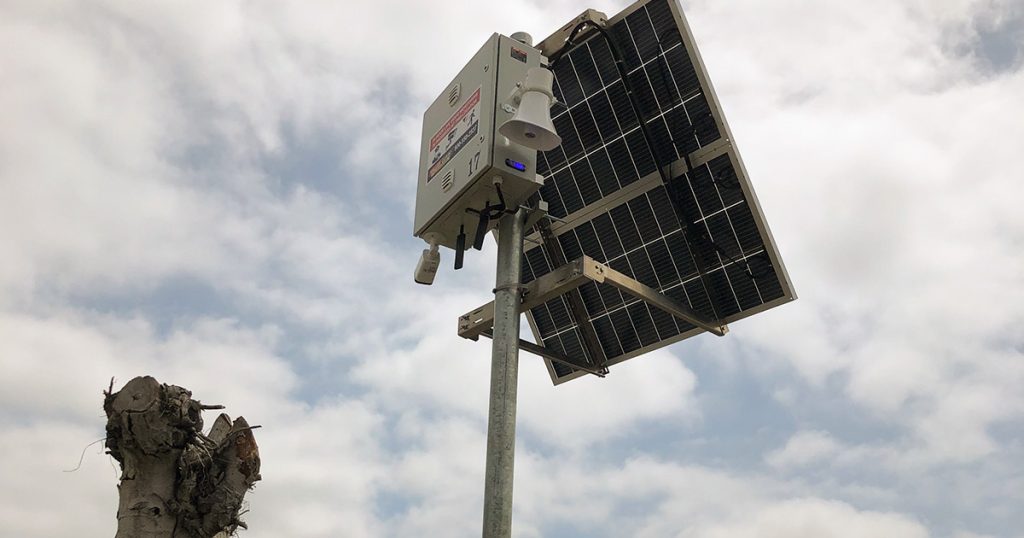
Mobile surveillance and repositionable cameras are deployed and redeployed as projects progress. When a jobsite is completed, units don't sit idle. They move to your next location. When project phases change and security needs shift, cameras are relocated to cover new risk areas.
Solar-powered options work for sites without power infrastructure or remote staging areas where running electricity isn't practical.
Cellular connectivity provides network access without relying on WiFi. This flexibility makes monitoring multiple job sites operationally feasible regardless of individual site conditions.
Dashboard Systems for Project Managers
Alerts are delivered to centralized apps for quick triage across all locations. When incidents occur, you see which site, which camera, what type of activity, and what response operators initiated, all in one interface.
Integration with project management workflows means security doesn't exist in a silo. Incident reports feed into your existing dashboards alongside schedule updates, budget tracking, and crew assignments.
Real Proof: How Contractors Scaled Security
Eberhard LLC Across Multiple Projects
Robert Marshall is the Safety Director at Eberhard, a roofing, waterproofing, and architectural sheet metal company. His job is to keep equipment, materials, and work vehicles protected, often while projects and yards change week to week.
Before ValleyGuard, the problem wasn't just theft. It was the combination of repeated break-ins, catalytic converter thefts, and constant false alarms that created "sleepless nights." He described getting hit with nuisance alerts, then having to guess whether each one was real or just birds, wind, or background movement.
After Eberhard brought in ValleyGuard, the biggest change was centralized, scalable protection without the guard-heavy staffing model. Instead of relying on people to be everywhere at once, the system uses AI to focus on real threats, such as people, and filter out distractions.
When an intrusion attempt occurs, live operators can immediately use the on-site speaker to warn the person off in real time, before theft occurs.
Marshall says that live talk-down response is what made the difference: when ValleyGuard notices an intruder trying to break in, "they'll get on the speaker and scare them off." The result was fewer theft incidents, fewer false alarms, and a noticeably safer operation overall. He felt the solution "made a lot of sense" financially compared to paying for guards that still leave coverage gaps.
He recommends ValleyGuard for any business dealing with repeated break-ins and theft, especially if you're trying to protect multiple active locations without multiplying guard costs every time you add a new project.
Watch Robert Marshall's 90-second ValleyGuard testimonial.
Local LA Risk Patterns That Compound Across Sites
Los Angeles jobsite security challenges compound when managing multiple locations because organized theft rings operate across wide geographic areas. The same thieves hitting sites in Burbank also target projects in Glendale, Pasadena, and North Hollywood.
High-density construction activity in LA County means your multiple sites often sit within 10 to 20 miles of each other.
Thieves survey several locations, identify the least protected, and strike during predicted vulnerability windows. Without centralized monitoring, you might not even realize the same crew is targeting multiple projects in your portfolio.
Frequent theft attempts at unattended sites become pattern data with centralized visibility. You notice that Friday nights see elevated activity.
Or that a specific neighborhood experiences more intrusions than others. This intelligence lets you adjust security priorities across your entire portfolio instead of treating each site as an isolated incident.
Why Guard-Based Security Breaks Down at Scale
Seven sites means seven guard payrolls. $126,000 to $151,200 monthly just for overnight coverage at each location. That's before overtime, benefits, workers' compensation, scheduling overhead, or the fact that each guard can only patrol 2 to 3 acres at a time.
The cost scales linearly. Every new project adds another guard, another payroll line, another scheduling problem. And the coverage is still incomplete. Guards take breaks. Shifts change. One person can’t fully cover large sites.
Centralized remote monitoring doesn't work that way. One monitoring center covers all your sites simultaneously. Adding a new location doesn't require adding a new guard. It requires adding cameras. The overhead stays flat while coverage expands.
For contractors managing 3 to 7 active sites, the math changes completely once you stop thinking site-by-site and start thinking portfolio-wide.
FAQs: Scaling Security Across Job Sites
How do I monitor 3-7 sites without being overwhelmed?
Centralized monitoring centers handle the oversight burden. Operators watch all your sites simultaneously from unified dashboards. AI filters out alerts so you only receive verified threats that require attention.
Instead of managing seven different camera systems and reviewing hundreds of alerts daily, you receive 5 to 10 notifications weekly for genuine incidents that operators have already verified and responded to.
What happens if suspicious activity is detected on one site?
Operators see the activity within 3 to 5 seconds regardless of which site the breach occurs at. They verify the threat, issue live audio warnings through on-site speakers, and escalate to police dispatch if intruders don't leave.
You receive a notification of the incident, including video clips and operator notes. Most intrusions stop at the audio warning stage before any theft occurs.
Is remote monitoring more cost-effective than multiple guards?
For contractors managing multiple sites, yes. Guards require dedicated staffing at each location, with costs multiplying linearly as you add projects.
Remote monitoring covers all locations from a centralized platform, so adding a new site means adding cameras rather than adding another full-time guard payroll.
Cameras also see everywhere simultaneously, while guards can only patrol limited areas at a time. Use the construction site security cost calculator to see how the numbers break down for your specific number of sites and guard setup.
Can one system really cover sites across LA County?
Yes. Monitoring centers handle geographic distribution easily because cameras connect through cellular or internet regardless of physical location. Your sites in Burbank, Glendale, Pasadena, Long Beach, and the Inland Empire all feed into the same monitoring infrastructure.
Distance doesn't affect response capability because deterrence occurs through on-site speakers, and police dispatch works the same way whether the site is in North Hollywood or San Fernando.
Three sites. One monitoring contract. No per-site guard overhead.
ValleyGuard scales across multiple active construction sites without multiplying costs. US-based operators cover every location from a single center. Serving contractors across Greater Los Angeles since 1981.
Related Articles
- →Construction Site Security Guide for Los Angeles Contractors
- →Remote Construction Site Protection for LA Jobsites
- →Why LA Contractors Are Replacing Security Guards With Remote Video Monitoring
- →Overnight Construction Site Theft Prevention in LA
- →How ValleyGuard Stops Construction Theft
- →ValleyGuard Catches on Camera
- →Mobile Security Cameras for Construction Sites

- Remote Video Monitoring: The Complete Guide for Commercial Properties - August 13, 2026
- How Much Does Remote Video Monitoring Cost? - August 13, 2026
- Remote Video Monitoring for Apartment Complexes and Multi-Family Properties - August 13, 2026