
The Footage Is Clear. They Came Back Anyway.
The footage is clear. You can see exactly what they took, the truck they came in, and the direction they left. You filed a police report. And then nothing.
Three weeks later, they were back.
If your Los Angeles construction site has been robbed more than once despite having security cameras, the problem isn't the cameras—passive systems record theft. Live remote monitoring stops it. Valley Alarm's ValleyGuard service deploys AI-powered cameras with US-based operators who issue real-time audio warnings the moment an intruder is detected, before anything is taken.
If you're trying to understand exactly why passive cameras failed at your site, here's the technical breakdown. See why construction cameras don't stop theft for the structural gap between recording and responding.
Jump to: The repeating pattern | Repeat targeting | Daylight theft | No plan, just footage | What passive means | The guard problem | Intervention | ValleyGuard on LA sites
The Pattern That Keeps Repeating
A site gets hit. Cameras capture everything. A police report gets filed. The stolen tools, copper wire, generators, or equipment are rarely recovered. In Los Angeles County, only 22% of stolen construction equipment is ever returned.
The contractor installs additional cameras. The site gets hit again.
This cycle is predictable because it's driven by how organized theft operations actually work. They probe sites, confirm that no one intervenes in real time, and return.
Sometimes the same week. Sometimes the same weekend, because a second crew takes advantage of the same access point. Repeat targeting is the sharpest version of a broader problem.
The guide to construction site security in Los Angeles covers the full set, from deployment choices to what insurers now expect.
The camera didn't fail. The system did. Recording isn't the same as responding.
Repeat Targeting Is a Decision, Not a Coincidence
Getting robbed twice doesn't mean you were unlucky twice. It means the crew confirmed you have no live response capability and calculated that returning was worth the risk.
Organized theft rings treat passive camera sites as a known quantity. Camera positions are visible from the street or a parked vehicle before anyone sets foot on the property. Coverage gaps are mapped. Response time from recorded footage is measured in hours, not minutes.
Once a site is confirmed passive, it becomes a scheduled stop.
A modular construction company in our network in Carson was hit on multiple occasions over a three-month period.
ValleyGuard records show incidents on November 10, November 15, November 19, and February 20, spanning a Sunday evening, a Saturday night, a Wednesday predawn, and a Thursday midnight.
Police were dispatched each time. Some patrols arrived to find suspects already gone. The site was targeted repeatedly because the pattern held.
Daylight Doesn't Change the Math
ValleyGuard records show that on March 22, 2026, a Sunday afternoon at 1:00 PM, an unauthorized vehicle entered the customer’s construction site in Carson. The site was closed. ValleyGuard Intervention Specialists issued multiple audio warnings. LA County Sheriff was dispatched.
Think about what Sunday afternoon looks like to someone watching the work schedule.
The crew clocks out Friday. Nobody comes back until Monday. That's 60-plus hours where the only question is whether anyone is watching.
ValleyGuard records show that on March 12, 2026, an individual in a bright yellow shirt entered a customer’s construction site on Cahuenga Boulevard in Hollywood during non-work hours.
ValleyGuard operators issued multiple audio warnings. Police were contacted, and the individual was identified by clothing description from the live camera feed.
Hollywood, daytime, a non-residential construction corridor, still targeted during the gap between crew departure and morning return. Both incidents, same pattern: cameras operational, operator watching, warnings issued. Neither became a loss.
A construction site on Sunset Boulevard in Los Angeles logged 37 separate ValleyGuard responses in a five-month period. Four individuals were detected on a January afternoon; audio deterrents were issued, and authorities were contacted. Active corridors attract repeat attempts. What changed each time was the outcome.
See documented ValleyGuard interventions at active Los Angeles construction sites in ValleyGuard catches on camera.
No Plan. Just Footage.
When a site is hit twice in the same week, it's almost never two unrelated incidents. The second crew is usually operating on information from the first.
They know where the tools were staged, which gate the first crew used, and the camera system's response time.
Experienced crews treat passive camera systems as documentation tools, not deterrents. Before they enter a site, they've already done their homework.
Coverage gaps are mapped. Working quickly within those gaps keeps them inside a safe operational window: the time between entry and any realistic human response.
The result: a site with eight cameras and motion alerts sent to the contractor's phone has nearly the same deterrent value as a site with two cameras.
The cameras record. Nobody responds in real time. The theft completes before anyone knows it happened.
Motion-triggered phone alerts look like a solution. In practice, a contractor gets an alert at 2:00 AM, checks the thumbnail, and can't tell whether it's a person, a tarp in the wind, or a stray animal. By the time they confirm it's real, the crew is gone.
What "Passive" Means to a Professional Theft Crew
An experienced crew doesn't guess at response times. They test them. A scout goes first. If nothing happens- no alarm, no audio, no police- the site is confirmed passive. The main crew follows.
This is why the first incident at a construction site is rarely the last. The scout trip confirmed that the site is safe to work on. "nd ""afe" in this context means no one will intervene while they load a truck.
Why Security Guards Have the Same Structural Problem
Guards cover a shift. A single person can't simultaneously monitor every entry point on a multi-acre construction site, maintain full alertness through an eight-hour overnight shift, and safely intervene against a crew of four or five people.
Shift transitions create reliable coverage gaps in which the incoming guard is still orienting while the outgoing guard has already left.
Patrol patterns are predictable. One full perimeter circuit takes approximately the same time every pass. Crews time their entry for guards' back positions.
Dave Michel, Valley Alarm's Co-President and President of the Greater Los Angeles Alarm Security Association (GLASAA), has observed this structural limitation throughout his 40-plus years in LA commercial security:
"One person can't provide full perimeter monitoring of a large active site without blind spots, fatigue, and coverage gaps that experienced crews can time precisely. That isn't a criticism of individual guards. It's a description of what one person physically can and can't do."
For more on how remote monitoring compares structurally to guard coverage, see how ValleyGuard stops construction theft in real time.
Intervention: What Changes When Someone Is Actually Watching
When a ValleyGuard operator is watching the live feed, the sequence changes completely. The AI camera detects activity. The alert is sent to a US-based Intervention Specialist, who assesses the feed in real time. If the activity is unauthorized, a live audio warning goes through the on-site speaker immediately.
The warning is specific. The operator identifies what they see and addresses the individual directly. On March 22 in Carson, the sheriff was dispatched. On March 12 in Hollywood, police were contacted, and the individual was identified from the live feed.
Neither incident produced a loss. That's real-time human intervention doing what cameras can't.
ValleyGuard for Active Los Angeles Construction Sites
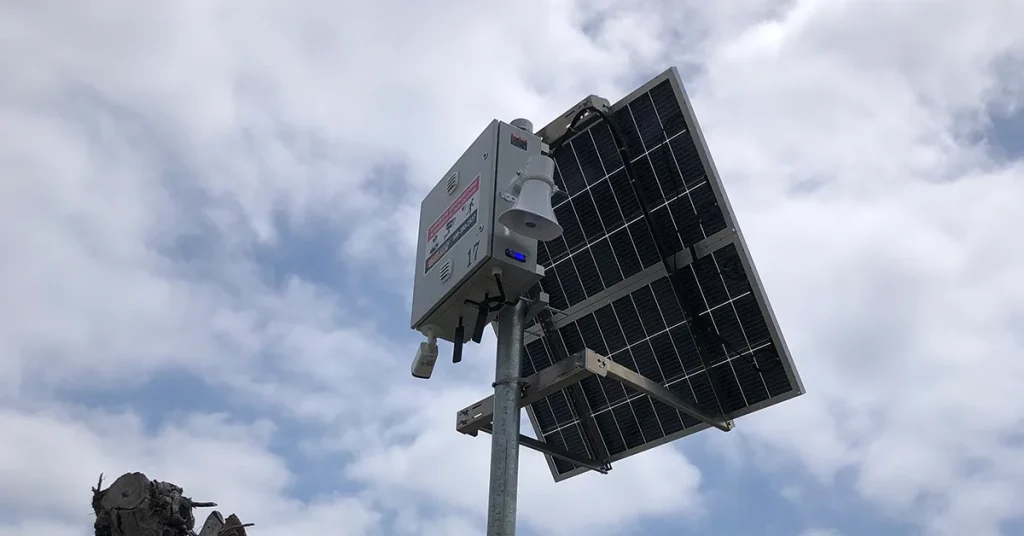
ValleyGuard deployments are designed for active construction site conditions. Solar-powered cameras deploy without hardwired power. Mobile security trailers cover large or irregular site footprints. Both options are operational within 24 to 48 hours of a site assessment.
Coverage moves with the site. When the foundation is poured and framing begins, the high-risk areas change. The deployment adjusts accordingly. All monitoring is handled by US-based Intervention Specialists, not overseas call centers.
Valley Alarm's ValleyGuard system has stopped construction site theft across Greater Los Angeles since 1981, with real-time human intervention, not just recording. Request a consultation for your site.
Frequently Asked Questions
Why does my construction site keep getting robbed even with cameras?
Passive cameras record theft; they don't stop it. Organized theft operations probe sites in advance to confirm there's no live response. If the cameras only record, the crew knows they have time to work.
The solution isn't more cameras. It's a system with a trained person watching in real time and capable of intervening before anything is taken.
Does theft only happen overnight?
No. The W.A. Rasic Construction site in Carson was targeted at 1:00 PM on a Sunday. A Cahuenga Boulevard construction site in Hollywood was targeted on a Thursday afternoon. Crews who confirm a site has no live response work whenever it looks empty: afternoons, weekends, any gap in the schedule.
What equipment is most commonly stolen from construction sites in Los Angeles?
Copper wire, generators, power tools, HVAC equipment, and heavy machinery are the most frequent targets. Metal theft has increased as organized crews have expanded operations along the 10 and 15 freeways. Theft of catalytic converters from construction vehicles and equipment is increasingly common as well.
Do security guards prevent theft at construction sites?
Guards have a structural limitation: they can be in only one place at a time, and their patrol patterns are predictable.
A crew timed to enter during a patrol gap has time to load a truck before the guard returns. Live video monitoring doesn't have this limitation.
An Intervention Specialist can monitor all cameras simultaneously and respond without physically traveling to the threat.
How quickly can ValleyGuard be deployed at a Los Angeles construction site?
Solar-powered mobile trailers and pole cameras are operational within 24 to 48 hours of a site assessment. No hardwired power or permanent infrastructure is required. The deployment is temporary and can be repositioned as the site footprint changes throughout the build.
What is the detection-to-response time for ValleyGuard?
When an AI camera flags activity at a ValleyGuard-monitored construction site, the alert is sent immediately to a US-based Intervention Specialist, who assesses the live feed in real time. If the activity is confirmed unauthorized, a live audio warning is issued within seconds.
There is no travel time and no delay waiting for a contractor to check a phone notification. This response architecture is what separates active monitoring from passive recording.
Can ValleyGuard help recover stolen equipment?
ValleyGuard is designed to stop theft before it occurs. When an incident is stopped by an audio warning, law enforcement is contacted with live video. If a theft occurs despite monitoring, the timestamped video and operator log provide documentation for police and insurance claims.
Passive cameras record the theft. ValleyGuard stops it before it's over.
Solar-powered deployment. 24- to 48-hour setup. US-based operators watching your site around the clock. Valley Alarm has served construction sites across Greater Los Angeles since 1981.
Related Articles

- Remote Video Monitoring: The Complete Guide for Commercial Properties - August 13, 2026
- How Much Does Remote Video Monitoring Cost? - August 13, 2026
- Remote Video Monitoring for Apartment Complexes and Multi-Family Properties - August 13, 2026